

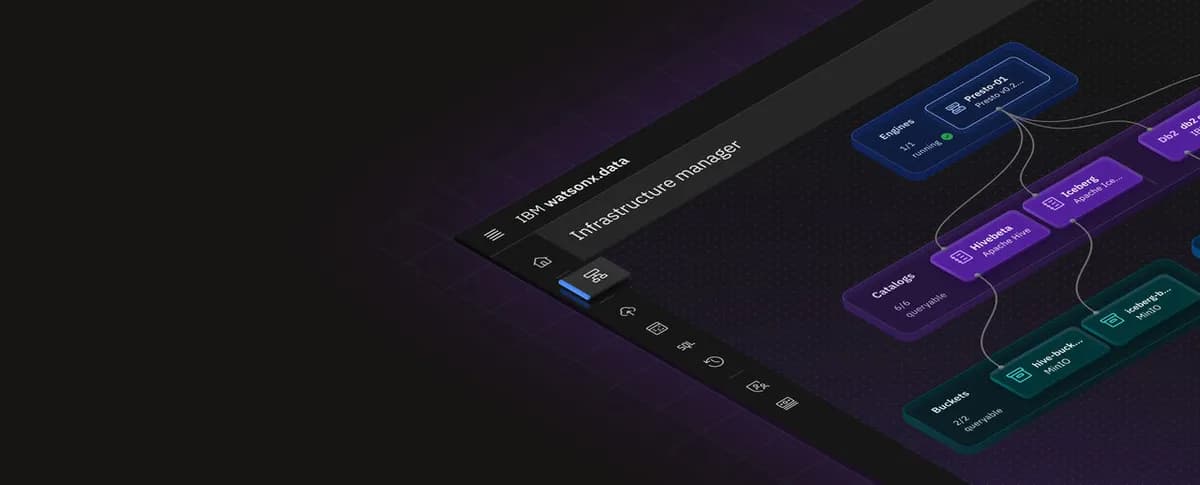

The useful question about IBM watsonx.data is not whether it stores data well, but how it stacks up against the way most teams actually run analytics and AI today. Many organizations already have a warehouse, a lake, and a growing pile of unstructured data spread across on-premises systems and more than one cloud. watsonx.data positions itself as the layer that unifies that sprawl into a single governed lakehouse and then routes queries to whichever engine is cheapest for the job. That framing tells you a lot about who it is for and who will find it overkill.
It is worth being clear up front about what this product is. watsonx.data is one component of IBM's broader watsonx family; it is the data foundation, not the model-building studio. If you are evaluating it, you are almost certainly evaluating it as the storage-and-query tier that will sit underneath analytics dashboards and AI training pipelines, not as a standalone BI tool.
Where it tries to differentiate
The design choice that sets watsonx.data apart from a traditional proprietary warehouse is that it is built on an open lakehouse architecture using Apache Iceberg as the table format and open engines such as Presto and Spark for querying. This matters for a practical reason: Iceberg is an open standard, so the data you land in the lakehouse is not locked into a single vendor's storage format. In principle you can point other Iceberg-compatible tools at the same tables, which lowers the long-term risk of being trapped by one query engine's pricing or roadmap.
- Multiple query engines, including IBM's own and open-source options. The value here is fit-for-purpose compute. Interactive SQL exploration, large batch transforms, and machine-learning feature preparation have different performance profiles, and being able to run the right engine against the same governed data avoids copying it into three separate systems.
- Cost-aware workload routing. watsonx.data is described as being able to route workloads to the most efficient compute engine. The intended benefit is straightforward: not every query deserves an expensive warehouse engine, and pushing lighter work to cheaper compute is where large analytics bills are usually trimmed.
- Governance built in, not bolted on. Fine-grained access control, lineage tracking, and centralized data governance are core to the pitch. For a regulated enterprise, lineage and access control are frequently the deciding factors, because an AI model trained on ungoverned or unauditable data is a liability rather than an asset.
- A direct line to watsonx.ai. The lakehouse integrates with IBM watsonx.ai for model training and inference, so the governed data can feed AI work without a separate export step. If your organization has already committed to the watsonx stack, this tight coupling is the main reason to prefer watsonx.data over a neutral third-party lakehouse.
Deployment reach
watsonx.data supports hybrid and multicloud deployment, spanning on-premises infrastructure alongside major public clouds. The reason this is more than a checkbox is that enterprise data rarely lives in one place. A bank might keep customer records on-premises for regulatory reasons while running analytics in a public cloud; a lakehouse that can query across both without forcing a full migration reduces the cost and risk of consolidation. The tradeoff is that hybrid deployments are inherently more complex to configure and operate than a single-cloud SaaS product, and that complexity is real work.
Pricing measured against value
IBM offers watsonx.data as a cloud service with consumption-based pricing, and a free trial is available on IBM Cloud to explore the platform. Enterprise licensing is negotiated directly with IBM rather than published as fixed tiers. IBM does not publish a specific starting price or detailed usage rates in the facts available for this review, so anyone budgeting for it should treat the trial as an evaluation tool and get a written quote before committing.
Consumption pricing is a double-edged model. It is efficient when workloads are spiky, because you are not paying for idle capacity, and the cost-routing feature is meant to lean into that. But consumption billing also makes spend harder to forecast, and it rewards teams that actively manage query patterns and engine selection. If your organization cannot dedicate someone to watching usage, a consumption model can drift upward quietly. The honest read is that the value proposition holds up best for teams with enough data volume and workload variety that engine flexibility and governance actually pay for themselves.
The case against it
This is not a tool that suits every situation, and pretending otherwise would be a disservice.
- It is aimed at large enterprises. The facts describe it as best suited to large organizations and data engineering teams needing a governed, scalable foundation. A small team with a single database and modest reporting needs will find the architecture heavier than the problem warrants.
- Operational expertise is assumed. Iceberg, Presto, Spark, governance policies, and hybrid deployment all presume in-house data engineering skill. The platform lowers some friction, but it does not remove the need for people who understand distributed query engines and data governance.
- Pricing opacity. Because enterprise licensing is negotiated and usage rates are not publicly detailed here, the true cost is hard to estimate before engaging IBM sales. That is normal for enterprise software, but it slows down bottom-up evaluation.
- Ecosystem gravity. The tight integration with watsonx.ai is a genuine strength if you are in the IBM camp and a weaker draw if your AI tooling lives elsewhere. The open Iceberg foundation mitigates lock-in on the storage side, but the deepest workflow benefits assume you adopt more of the watsonx family.
How to think about alternatives
The lakehouse category is crowded, and the practical alternatives fall into recognizable groups rather than a single competitor. There are the major cloud providers' own lakehouse and warehouse offerings, which can be the path of least resistance if your data already sits inside one cloud. There are independent lakehouse and query platforms built around open table formats, which appeal to teams that want engine neutrality above all. And there is the option of assembling your own stack directly on open-source Iceberg, Presto, and Spark, trading vendor support for maximum control. watsonx.data's argument against all three is the combination of open formats, built-in governance, hybrid reach, and a native path into watsonx.ai. Whether that bundle is worth it depends heavily on how much of the IBM ecosystem you already use. You can compare it with other options in AI data analytics tools or browse the wider tool directory before committing.
Final assessment
IBM watsonx.data is a credible choice for a specific buyer: an enterprise with data scattered across on-premises and multiple clouds, a real data engineering team, and a plan to use that data for AI. The open Iceberg foundation is a meaningful hedge against storage lock-in, the multi-engine and cost-routing design targets the part of the bill that actually hurts, and governance is treated as a first-class concern rather than an afterthought. The reservations are equally clear: it expects scale, skill, and a sales conversation to price, and it delivers the most value to organizations already leaning into watsonx.ai. Smaller teams and single-cloud shops should evaluate their provider's native options first. Larger, hybrid, governance-conscious organizations are the ones for whom this platform was designed, and they should use the IBM Cloud trial to pressure-test it against their real workloads before signing anything. For related reading, see our blog.
Common questions about IBM watsonx.data
Is IBM watsonx.data the same as watsonx.ai?
No. watsonx.data is the data lakehouse component of IBM's watsonx platform. It provides governed storage and query engines, and it integrates with watsonx.ai for AI model training and inference. They are complementary pieces rather than the same product.
What table format and query engines does it use?
It is built on an open lakehouse architecture using Apache Iceberg as the table format, with support for multiple query engines including Presto and Spark alongside IBM's own engines. The intent is to let teams pick the most suitable and cost-effective engine for each workload.
Can it run across on-premises and multiple clouds?
Yes. watsonx.data supports hybrid and multicloud deployment, so it can connect data across on-premises systems and public cloud environments rather than requiring everything to live in one place.
Is there a free way to try it?
A free trial is available on IBM Cloud so you can explore the platform. Beyond the trial, it is offered as a consumption-based cloud service, and enterprise licensing is negotiated directly with IBM.
Who gets the most out of it?
It is aimed at large enterprises and data engineering teams that need a governed, scalable data foundation for AI and advanced analytics spanning hybrid cloud and on-premises infrastructure. Smaller teams with simpler needs are likely to find it heavier than necessary.