
Analytics vendors have promised "ask your data a question" for the better part of a decade, and most implementations quietly disappoint the moment a business user phrases something the way a human actually would. ThoughtSpot is worth examining precisely because it approaches that problem from a different angle than the text-to-SQL wrappers that have flooded the market since large language models became cheap to embed. What you are really evaluating here is not a chatbot bolted onto a dashboard, but a search-and-modeling layer that sits between people and cloud data warehouses.
What ThoughtSpot Is Actually Doing
At its core, ThoughtSpot lets people query live data by typing or speaking questions in plain language and get back interactive charts and answers. The company now positions the product as an "agentic analytics platform," which is marketing shorthand for the more interesting technical decision underneath it: rather than translating your question directly into SQL and hoping the model guessed your table joins correctly, ThoughtSpot resolves questions into search tokens grounded in a governed semantic model. That model defines the joins, calculations, calendars, and security rules before anyone asks anything.
This distinction matters more than it sounds. Direct text-to-SQL is fast to demo and unreliable in production, because the same business term can mean three different things across three tables, and a model has no way to know which one your finance team considers canonical. By forcing queries through a defined semantic layer, ThoughtSpot trades some of the open-ended flexibility of a raw LLM for answers that are traceable and consistent with agreed business definitions. For a regulated enterprise, that is usually the right trade. For a solo analyst who wants to poke at a messy CSV, it is overhead.
The AI Layer: Spotter and Automated Insights
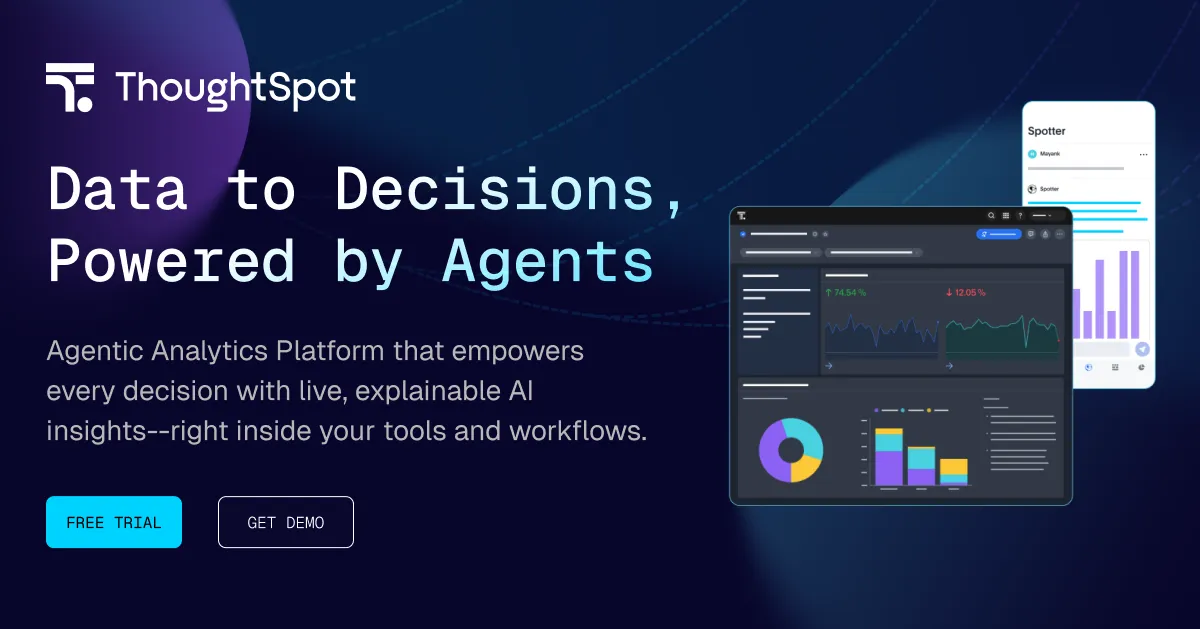
The headline AI feature is Spotter, described by the vendor as an enterprise analytics agent. Beyond answering a single question, Spotter is built to break a request into steps, run multi-step analysis, test assumptions, verify results, and surface recommended actions. Whether it consistently delivers on the "reasons like a skilled analyst" framing is something any buyer should stress-test during a trial with their own messy data, but the architectural intent is clear: it is meant to behave like an assistant that shows its work, not a black box that returns a number.
Around Spotter sit a few named capabilities. SpotterModel handles automated semantic modeling, SpotterViz turns data into dashboards, and SpotterCode provides AI-assisted coding. Separately, ThoughtSpot's automated insights surface anomalies, drivers, and trends across data models without someone manually building a report to find them. This proactive surfacing is genuinely useful for teams that don't know what question to ask yet, though it can also generate noise if the underlying model isn't well curated first.
Two governance details are worth calling out because they address common enterprise objections. Spotter supports role-based access control alongside row-level and column-level security, and the vendor states there is zero LLM data retention. If confirmed against your own compliance requirements, that retention posture removes one of the more persistent blockers to putting a generative feature in front of sensitive corporate data.
Where It Fits Into a Data Stack
ThoughtSpot connects directly to the major cloud data warehouses, including Snowflake, BigQuery, Databricks, and Redshift, with broader "any data" connectivity beyond those. This is a live-query approach against the warehouse rather than a proprietary data store you have to load and maintain, which keeps a single source of truth and avoids the stale-extract problem that plagues older BI tools.
On the delivery side, results live in Liveboards, the interactive boards that support drill-down and follow-up questions, and the platform can push insights into where work happens. Documented integrations include Slack, Salesforce, Google Slides, and mobile, and the actionable outputs go a step further, creating Jira tickets, updating Salesforce records, or triggering workflows. There is also a notable integration story on the AI side: ThoughtSpot lists connections to OpenAI, Claude, Gemini, and Cursor, signaling it does not tie you to a single model provider.
The embedded analytics path is a distinct use case rather than an afterthought. Product companies can embed governed dashboards and Spotter into their own customer-facing applications through an API and SDK. If you are building a data product for external users, this is often the deciding feature, because rebuilding governed multi-tenant analytics in-house is expensive and slow.
Who Should Look Closely, and Who Should Not
The realistic fit is a data-driven organization that already runs a cloud warehouse and wants to reduce the queue of report requests hitting a central analytics team. It suits companies that value governance and consistent definitions enough to invest in modeling upfront. Product teams needing embedded, customer-facing analytics are a second strong fit.
It is a poor fit for an individual or a small team that just wants ad hoc charts from a spreadsheet without building a semantic model, and it is overkill where a lightweight dashboard tool would do. The value depends heavily on the quality of the semantic layer you feed it; a rushed or inconsistent model will produce confident, governed, and still wrong answers. Budget real time for that setup work.
Pricing, As Published
ThoughtSpot publishes its analytics pricing, which is more transparency than much of the enterprise BI market offers. The Essentials plan starts at $25 per user per month billed annually, sized for 5 to 50 users and up to 25 million rows. The Pro plan is offered either usage-based at $0.10 per query or at $50 per user per month, scales from 25 to 1,000 users and up to 250 million rows, and includes the Spotter AI agent at 25 queries per month per user plus Analyst Studio. The Enterprise plan is custom-priced with unlimited users and data and adds enterprise support with a one-hour SLA.
| Plan | Starting price | Users | Data |
|---|---|---|---|
| Essentials | $25/user/mo (annual) | 5–50 | Up to 25M rows |
| Pro | $0.10/query or $50/user/mo | 25–1,000 | Up to 250M rows |
| Enterprise | Custom | Unlimited | Unlimited |
For embedded use, there is a Developer tier the vendor lists as free for one year, covering up to 10 users and 25 million rows with embeddable dashboards, API and SDK, and visualization tools, plus an Enterprise Embedded tier with flexible usage-based pricing. A free trial is also offered. The metered Spotter query cap on Pro is the number to watch: 25 AI queries per user per month sounds generous until an enthusiastic team adopts conversational analytics daily, at which point the usage-based math deserves modeling before you commit. You can compare it against other options in the AI data analytics category, and browse the broader tools directory for adjacent BI and reporting software.
Verdict
ThoughtSpot is a serious, warehouse-native analytics platform whose main differentiator is that it channels natural-language questions through a governed semantic model instead of trusting an LLM to write correct SQL on the fly. That design choice, combined with published pricing, documented security controls including zero LLM retention, and a real embedded-analytics story, makes it a credible option for enterprises that want self-service without surrendering data governance. The caveats are equally concrete: the semantic modeling is work you cannot skip, the AI-query metering on the Pro tier needs cost planning, and the platform is more than a small team needs. Evaluate it in a trial against your own data before believing any "ask anything" claim, from ThoughtSpot or anyone else. For more comparisons and buying guidance, our blog covers related analytics tooling.
Common Questions About ThoughtSpot
Does ThoughtSpot require you to know SQL?
No. The platform is built around natural-language search, so business users ask questions in plain language rather than writing SQL. Under the hood, questions are resolved through a governed semantic model, which is the layer a data team configures once so that non-technical users get consistent answers.
What is Spotter?
Spotter is ThoughtSpot's AI analytics agent. It answers questions conversationally, breaks them into multi-step analysis, verifies results, and can recommend or trigger actions such as creating Jira tickets or updating Salesforce records. It is included on the Pro plan with a limit of 25 queries per user per month, and on Enterprise tiers.
Which data warehouses does ThoughtSpot connect to?
The vendor documents direct connectivity to Snowflake, BigQuery, Databricks, and Redshift, with broader connectivity beyond those. It queries the warehouse directly rather than requiring you to load data into a separate proprietary store.
Is there a free option?
ThoughtSpot offers a free trial, and its embedded Developer tier is listed as free for one year for up to 10 users and 25 million rows. Beyond that, paid analytics plans start at $25 per user per month for Essentials.
Can ThoughtSpot be embedded into another application?
Yes. ThoughtSpot provides embedded analytics through an API and SDK, letting product teams put governed dashboards and the Spotter agent inside their own customer-facing applications. This is offered through a Developer tier and an Enterprise Embedded tier with usage-based pricing.