
Every category eventually produces a few tools that stop trying to be a better version of the incumbent and instead pick a specific job to own. Grain sits in the crowded field of meeting recorders, but the way it frames itself has shifted: it is less "another Otter or Fireflies" and more a system for capturing calls cleanly and then routing that captured context wherever the actual work happens, including into AI assistants. That reframing is the most interesting thing about the product, and it is worth judging on those terms rather than on transcription accuracy alone.
What Grain actually is on first look
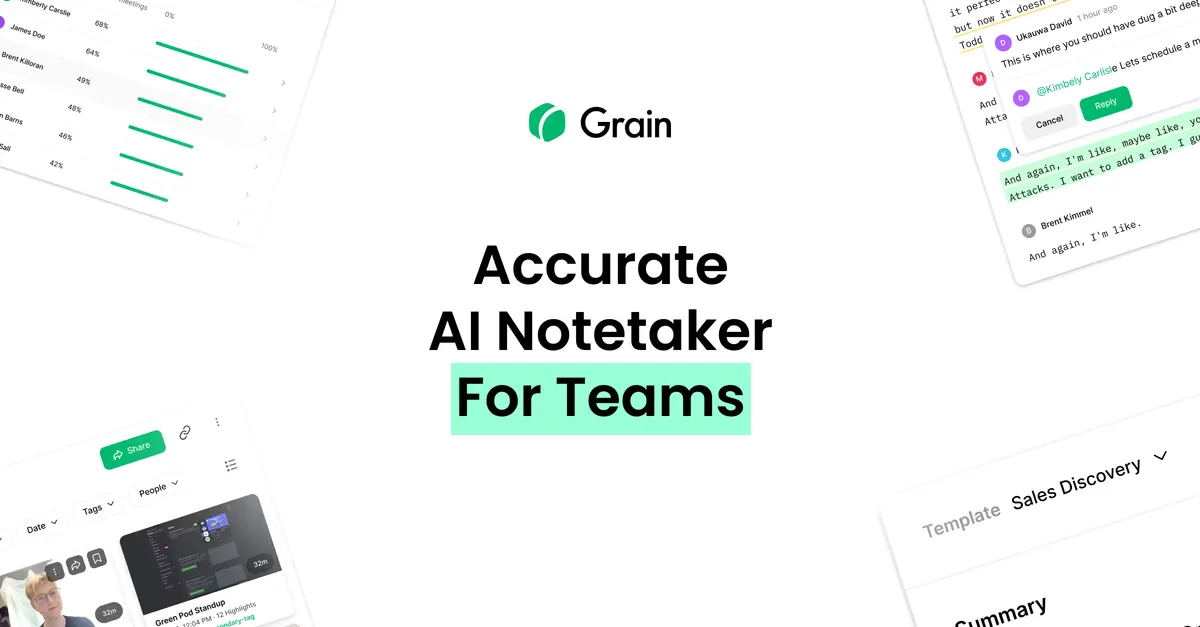
At its core, Grain joins your video calls, records them, and produces a searchable transcript with speaker attribution. From that transcript it generates meeting notes, a recap, and extracted next steps, so the person who ran the call is not stuck writing everything down afterward. It works across the meeting platforms most teams already use, Zoom, Google Meet, Microsoft Teams, and Webex, and can also capture Slack huddles. According to Grain's site it supports transcription in more than 130 languages, which matters if your calls are not exclusively in English.
One design decision stands out early. Grain offers a bot-less capture mode that records through your computer's audio rather than sending a visible bot into the meeting, with the traditional bot available as an option. That distinction is not cosmetic. A recording bot that shows up in the participant list changes the tone of a call, especially external ones with prospects or candidates, and some people clam up the moment they see it. Being able to capture without that signal is genuinely useful for client-facing conversations, though it also raises a consent question you should not wave away: recording someone who has not clearly agreed to it is a legal and ethical issue in many jurisdictions regardless of how discreet the tooling is. Grain's capture rules let you automate which meetings get recorded, which is where you should also encode your own disclosure practices.
The features that carry the product
Beyond recording, the parts of Grain that earn their place are the ones that reduce the manual work of turning a call into something the rest of the team can use.
- Highlight clips and shareable moments. You can grab a specific segment of a recording and share it as a clip. In practice this is how the tool proves its value: instead of forwarding a 45-minute recording, you send the two minutes where the customer described their real objection, or the moment a candidate answered the question the hiring manager cared about.
- AI notes, recaps, and next steps. Automatic summaries and action-item extraction are available across plans, including the free tier. These are the features you will use every single day, so their quality determines whether Grain saves time or quietly creates cleanup work.
- A searchable meeting library. Search across your entire history of calls turns past meetings into a reference you can actually query, which is only valuable once you have enough recorded history to make searching worthwhile.
- CRM syncing. Grain integrates with HubSpot, Salesforce, and Pipedrive, pushing notes and call context onto the relevant records so reps are not copy-pasting after every call. It also connects to Slack and to Zapier for lighter automation.
Where Grain is trying to differentiate: feeding meetings to AI
The more forward-looking layer is Grain's positioning as a source of structured meeting context for AI tools. It offers one-click export of a meeting to Claude or ChatGPT, exposes an API, and provides an MCP server so AI agents can query transcripts and pull meeting history programmatically. It also has an in-product "ask anything" capability that answers questions across your meetings with citations back to the source.
Why this matters depends entirely on how you work. If your team already uses an AI assistant to draft follow-up emails, prep for the next call, or summarize a quarter of customer conversations, then a clean, enriched transcript in Markdown with participant context is a far better input than a raw recording. The MCP and API access is the part most competitors do not lead with, and it signals that Grain expects the meeting record to be an ingredient in downstream automation rather than a final artifact. The honest caveat is that this only pays off if you have the surrounding AI workflow to consume it; for a team that just wants notes emailed after a call, this layer is largely irrelevant, and you should not pay for it as if it were the point.
Who it fits, and who should look elsewhere
Grain's own targeting, borne out by the feature set, points at sales teams, customer success, product and user researchers, recruiters, and agencies or consultancies that need to share call context with clients. The common thread is not "lots of meetings" but "meetings whose contents other people need to see." The clip-sharing and CRM-sync features are built for that hand-off. The Business plan adds AI coaching, custom AI follow-up emails, and team interaction insights, which are aimed squarely at sales and CS managers who want to review rep behavior at scale rather than sit in on every call.
Teams that should be cautious: anyone whose meetings are highly confidential and who is uncomfortable with third-party recording infrastructure, and small teams whose note-taking need is occasional. If you record two calls a month, a recorder is not the tool you are missing.
What the pricing looks like
Grain uses a freemium model. The free plan is a real starting point rather than a demo: it includes AI notes and recaps but caps how much you can record, and Grain's site describes both a limited number of meetings and a meeting-length limit on the free tier, along with free viewer seats that let people watch recordings without being able to record themselves. Paid plans remove those recording limits.
The paid entry point is the Starter plan, which Grain lists starting in the mid-to-high teens of dollars per seat per month on annual billing, adding unlimited meetings, custom AI prompts, and transcript downloads. The Business plan sits above it and unlocks the coaching, custom AI follow-up emails, and interaction insights noted above; Grain does not publish a fixed price for Business on the pages reviewed. Enterprise is custom-quoted and gates certain features behind having all seats on that tier. Because the exact figures Grain surfaces varied slightly across its own pages during this review, treat the Starter price as an approximate anchor and confirm the current number and free-plan limits on Grain's pricing page before you commit, since these change. On the security side, Grain states it is SOC 2 Type II certified and runs on AWS with annual penetration testing, which is the baseline you would want before recording customer conversations.
The bottom line
Grain is a competent meeting recorder that has made a sensible bet: the recording is not the deliverable, the shareable moment and the reusable context are. The clip workflow, the CRM sync, and the deliberate investment in getting meeting data into AI tools give it a clearer point of view than a generic "we transcribe your calls" pitch. It is a strong fit for revenue and research teams that share calls across the organization and for anyone already building AI workflows on top of their conversations. It is a weaker fit for occasional note-takers and for organizations with strict recording constraints. The freemium tier is generous enough to test the core experience against your own meetings before paying, which is exactly how you should evaluate it. You can compare it with other options in AI meeting assistants, browse the broader tool directory, or read related guides on the blog.
Common questions about Grain
Does Grain require a bot to join my meetings?
No. Grain offers a bot-less capture mode that records through your computer's audio, and it also supports the conventional approach of adding the Grain bot to a call. The bot-less option is useful for external calls where a visible recorder in the participant list might change the conversation.
Which video conferencing platforms does Grain support?
Grain works with Zoom, Google Meet, Microsoft Teams, and Webex, and can also capture Slack huddles. It supports transcription in more than 130 languages according to the vendor.
Can Grain connect to my CRM?
Yes. Grain integrates with HubSpot, Salesforce, and Pipedrive to sync meeting notes and context onto records, and it also connects with Slack and Zapier. This is aimed at reducing manual data entry after calls.
How does Grain work with AI tools like Claude or ChatGPT?
Grain provides one-click export of a meeting to Claude or ChatGPT, an API, and an MCP server so AI agents can query transcripts and meeting history. It also has an in-app "ask anything" feature that answers questions across your meetings with citations.
Is there a free version of Grain?
Yes. Grain has a free plan that includes AI notes and recaps but limits how much you can record, along with free viewer seats. Paid plans, starting with Starter, remove the recording limits; confirm current prices and limits on Grain's pricing page as they change.