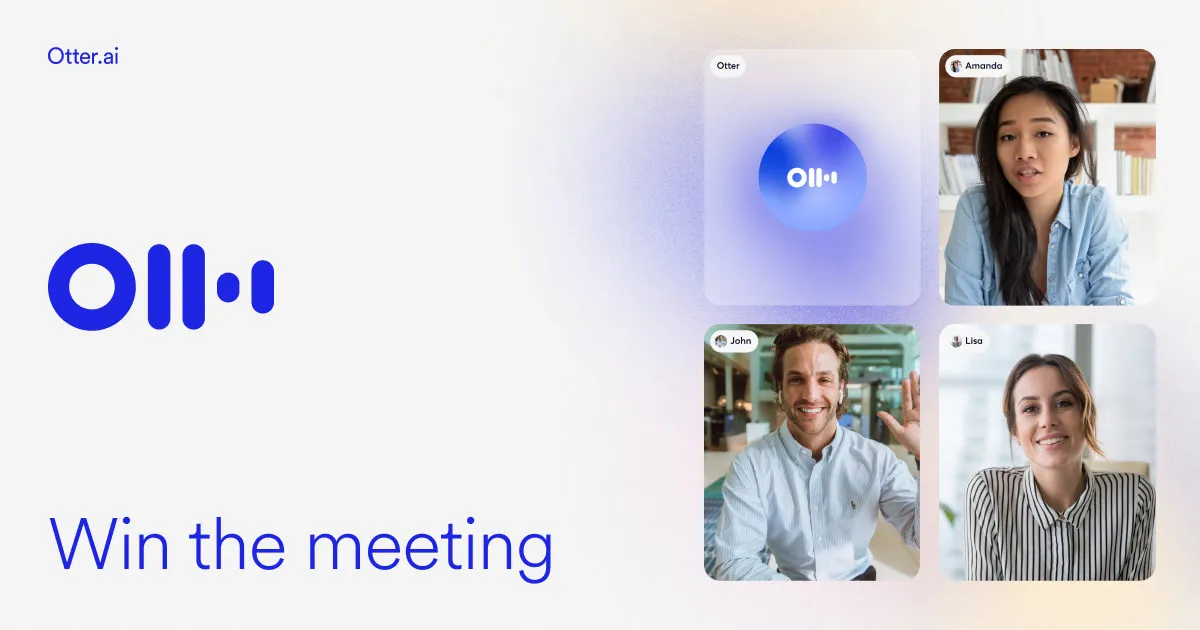

Otter.ai is a meeting assistant that records and transcribes spoken conversations, then turns them into searchable summaries with action items. If your day is a stack of Zoom, Google Meet, or Microsoft Teams calls and you are tired of typing notes while trying to listen, it targets exactly that problem, with the usual caveat that transcription accuracy and the free-plan minute cap will decide whether it earns a permanent place in your workflow.
What it actually does, and why each piece matters
The core of Otter.ai is real-time transcription. As a meeting runs, it produces a running transcript with speaker labels, so you can read along, correct names, and search the text the moment the call ends rather than scrubbing through a recording. Speaker identification is the feature that makes a transcript usable later: a wall of undifferentiated text is hard to act on, whereas knowing who committed to what turns the transcript into an accountability record.
After each conversation, Otter generates an automated summary that pulls out decisions, action items, and key points. This is where most of the day-to-day value sits. The realistic benefit is not that the summary is flawless, but that it gives you a reviewable draft in seconds instead of a blank page. You still skim and fix, but you start at 80 percent rather than zero. Action-item capture is genuinely useful for recurring team meetings and sales calls, where the follow-up is the whole point of the conversation.
OtterPilot is the branded assistant that joins scheduled calls automatically through your calendar so you do not have to remember to hit record. That automation is a double-edged tool: it is convenient, but a bot silently joining a call has social and consent implications, and some organizations restrict recording bots outright. Otter also offers a desktop recording mode on Mac and Windows that captures audio without joining the meeting as a visible bot participant, which is a meaningful option for teams that cannot or do not want to admit a third-party attendee into sensitive calls.
Otter AI Chat is a natural-language layer over your meeting archive. Instead of hunting through transcripts, you ask a question and it answers from across your meetings and connected apps, and it can draft follow-ups or reports. This matters most once you have accumulated dozens of meetings; the value of a searchable, question-answerable archive compounds over time. Early on, when you have five transcripts, the chat is a novelty. After six months of recorded standups and client calls, it becomes the reason you keep the tool. Note that chat usage is metered by query count per plan, so it is a budgeted resource rather than unlimited.
On integrations, Otter connects to Zoom, Google Meet, and Microsoft Teams for capture, and to Google Calendar, Google Docs, Dropbox, HubSpot, Jira, Notion, Salesforce, Slack, and Asana for pushing notes and action items into the tools where work continues. For sales teams, the Salesforce and HubSpot links are the ones that justify the spend, because a meeting summary that lands in the CRM without manual copying is a real time saving. It is available as a web app, desktop apps for Mac and Windows, iOS and Android apps, and a Chrome extension, so the capture point can follow you across devices.
You can browse similar products in the AI meeting assistant category if you want to compare capture-and-summarize approaches before committing.
Where it fits in real work
The clearest fit is recurring team meetings. Standups, planning sessions, and retrospectives all generate decisions that someone is supposed to remember, and Otter turns that into a shared, searchable note without a dedicated scribe. For sales development representatives and account teams, the pairing of automatic capture with CRM sync means discovery calls get logged with next steps attached, which is the kind of hygiene that usually slips when reps are busy.
Educators and students use transcription to turn lectures into reviewable text, and media professionals and recruiters lean on it for interviews, where an accurate record of exact wording matters. Otter markets to all of these groups, and the common thread is that they need a faithful text record of speech more than they need polished prose. Where I would be cautious is any setting with strict confidentiality, heavy jargon, or non-English or heavily accented speech: transcription tools in general degrade under those conditions, and you should run your own test call before trusting it with anything high-stakes.
Plans and what the tiers really gate
Otter uses a freemium model. The paid tiers are gated primarily on transcription minutes, per-conversation length, AI Chat queries, file imports, and admin controls rather than on the presence of the core features.
| Plan | Price | Monthly transcription minutes | Per-conversation limit | AI Chat queries |
|---|---|---|---|---|
| Basic | $0 | 300 | 30 minutes | 20 per user |
| Pro | $8.33/user/mo annual ($16.99 monthly) | 1,200 | 90 minutes | 50 per user |
| Business | $19.99/user/mo annual ($30 monthly) | Unlimited meetings | 4 hours | 200 per user |
| Enterprise | Custom | Unlimited | 4 hours | Not publicly listed |
The free Basic plan is a real trial of the workflow, not just a demo: it includes unlimited meetings but caps you at 300 transcription minutes per month, 30 minutes per conversation, three lifetime file imports, and a five-member workspace. That 30-minute per-conversation ceiling is the constraint most people hit first, because plenty of real meetings run longer. Pro raises the ceiling to 1,200 minutes and 90 minutes per call and adds Salesforce, HubSpot, and Zapier integrations plus unlimited storage. Business removes the meeting cap, extends conversations to four hours, allows up to 25 billed users, and adds admin features like activity logs and usage analytics along with prioritized support. Enterprise adds SSO, SCIM, Domain Capture, and HIPAA compliance as an add-on. If you handle protected health information, note that HIPAA is an Enterprise add-on rather than a default, so it requires the sales track.
For pricing math, the annual Pro rate is billed up front; the $8.33 figure is the effective monthly cost on the annual commitment, while month-to-month is $16.99. Budget against your real meeting volume: a light user may never exceed the Pro minute allotment, while a team doing back-to-back calls will need Business for the unlimited meetings alone.
Strengths worth paying for
- Real-time transcription with speaker labels that is immediately searchable, which shortens the gap between a meeting ending and having usable notes.
- Summaries and action-item extraction that give you an editable draft instead of a blank document.
- A genuinely useful chat layer over your meeting history that gets more valuable as the archive grows.
- A bot-free desktop recording option, which sidesteps the awkwardness and policy problems of a visible recording bot.
- A broad set of integrations, with the CRM connections being especially relevant for sales use.
- Coverage across web, Mac, Windows, iOS, Android, and Chrome so capture is available wherever the meeting happens.
Limitations and honest tradeoffs
- The free plan's 30-minute per-conversation limit and 300-minute monthly cap are tight enough that habitual users will hit a paywall quickly.
- AI Chat is metered by query count on every tier, so the search-your-meetings feature is a budgeted resource, not unlimited.
- Automatic bot joining raises consent and policy questions; recording participants without clear notice can breach both etiquette and, in some jurisdictions, law.
- Transcription accuracy is not published as a verified benchmark, and real-world quality drops with heavy accents, crosstalk, and specialized vocabulary, so test with your own audio before relying on it.
- HIPAA compliance is an Enterprise add-on rather than a standard feature, which matters for regulated fields.
- Non-English performance is not documented in detail on the pricing and product pages I reviewed, so multilingual teams should verify their languages directly.
Who should adopt it, and who should look elsewhere
Otter.ai is a sensible default for English-speaking teams that run frequent video meetings and want summaries and action items to land in tools like Slack, Notion, or a CRM with minimal manual effort. Sales teams, recruiters, and anyone managing a high volume of recurring calls will likely justify at least the Pro tier, and larger organizations that need admin controls and unlimited meetings should look at Business. The free plan is worth using as a genuine evaluation period rather than skipping straight to a paid tier.
If your priority is regulated-data handling out of the box, non-English or highly technical audio, or a strict no-recording-bot environment where even desktop capture is off the table, evaluate carefully and run a pilot before rolling it out. For most people the honest recommendation is to spend a week on Basic, watch where you hit the caps, and let your actual meeting volume decide the tier. You can compare it against other options in our tools directory or read related guidance on the blog.
Common questions about Otter.ai
Which meeting platforms does Otter.ai work with?
It integrates with Zoom, Google Meet, and Microsoft Teams for capturing calls, and connects to tools including Google Calendar, Google Docs, Dropbox, HubSpot, Jira, Notion, Salesforce, Slack, and Asana for routing notes and action items.
Is there a free version, and what are its limits?
Yes. The Basic plan is free and includes unlimited meetings but caps you at 300 transcription minutes per month, 30 minutes per conversation, three lifetime file imports, 20 AI Chat queries, and a five-member workspace.
How much do the paid plans cost?
Pro is $16.99 per user monthly or an effective $8.33 per user on annual billing; Business is $30 per user monthly or $19.99 on annual billing; and Enterprise is custom-priced through a sales demo.
Do I have to let a bot join my meetings?
Not necessarily. OtterPilot can join scheduled calls automatically, but Otter also offers a bot-free desktop recording mode on Mac and Windows that captures audio without joining the meeting as a visible participant.
Can Otter.ai handle regulated or sensitive data like health records?
HIPAA compliance is available as an add-on on the Enterprise plan rather than as a standard feature on the lower tiers, so regulated use requires the Enterprise track.