

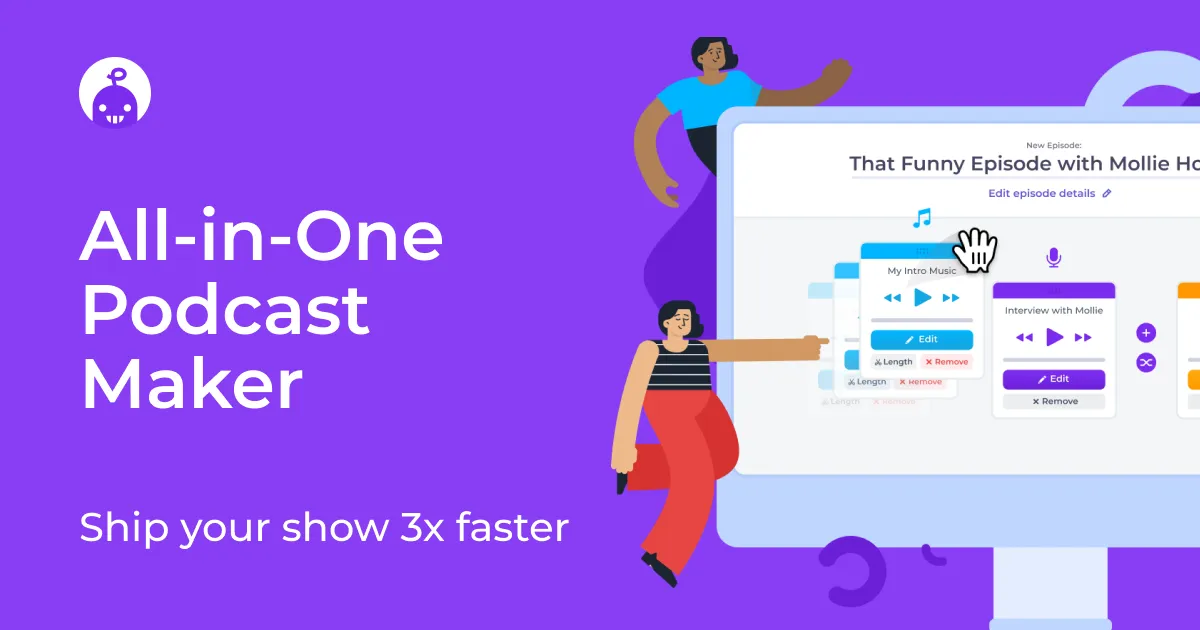

The reason a lot of podcasts never make it past episode three is not a shortage of ideas. It is the editing. Recording a conversation is the easy part; what follows is hours in a digital audio workstation cutting out mouth noise, matching the volume of two people who recorded at different levels, dropping in an intro, exporting the file, and then figuring out where the finished MP3 is actually supposed to go so a podcast app can find it. That workflow assumes a level of audio-engineering patience most creators do not have and do not want to acquire. Alitu is built around removing that middle step.
What Alitu is trying to solve
Alitu is a web-based podcast maker that takes raw audio and turns it into a finished, published episode without asking the user to open editing software. It records, cleans, assembles, transcribes, hosts, and distributes in one browser tab. The design assumption is that the person using it is a podcaster, not a sound engineer, and would rather spend their time on the content than on the mechanics of production. That framing is what separates it from general-purpose editors: it is opinionated software that makes production decisions on your behalf so you do not have to.
How the automation actually works
The core of the product is automatic audio processing. When you bring in a recording, Alitu applies noise reduction and level balancing without manual configuration. This matters in a specific, practical way: the most common flaw in amateur podcasts is not bad content but uneven, hissy, or muddy audio, and it is exactly the kind of problem that is tedious to fix by hand and easy to get wrong. Handing it to an automated pass gets a listenable result quickly, at the cost of the fine control an experienced editor would want. That is the central tradeoff of the whole tool, and it is worth being honest about it up front.
Recording happens inside the platform too. Alitu includes a built-in recorder for audio and video calls, so remote interviews can be captured without a separate service, and it also accepts uploads from a phone, from Zoom, or from a computer. For the editing itself, Alitu uses a transcript-based interface: the audio is transcribed and you edit by working with the text, which is far more approachable than scrubbing a waveform for anyone who is not used to one. The vendor frames the payoff as editing an episode in around twenty minutes, and while your mileage will depend on how much cleanup a recording needs, the transcript-driven approach is genuinely faster for basic cuts than timeline editing.
Once an episode is built, Alitu handles the parts that usually trip up beginners. It provides podcast hosting, a one-click path to publish to Apple Podcasts and Spotify, and a free podcast website that comes with the hosting. Transcription doubles as a source for show notes and is offered in 17 languages, which is useful both for accessibility and for giving each episode text that search engines and listeners can read.
Here is what a subscription includes, based on what the vendor publishes:
- Automatic audio cleanup, noise reduction, and level balancing applied without manual settings.
- A built-in recorder for audio and video calls, plus uploads from phone, Zoom, or computer.
- A transcript-based editor for cutting and assembling episodes.
- A royalty-free music and loops library for intros, outros, and beds.
- AI transcription for show notes, available in 17 languages.
- Podcast hosting, free for up to 1,000 downloads per month, with a paid tier at $10/month for up to 10,000 downloads.
- One-click publishing to Apple Podcasts and Spotify.
- A free podcast website bundled with hosting.
Where it will frustrate you
The convenience has real limits, and they follow directly from the design. Automated cleanup is a black box: it decides how aggressively to reduce noise and where to set levels, and when it gets a difficult recording wrong, there is not the same granular control a full editor gives you to fix it. Podcasters producing narrative or music-heavy shows, or anyone who cares about precise audio character, will feel boxed in. This is a tool for spoken-word content that needs to sound clean, not for productions that treat sound design as part of the art.
It is also web-based, which means it depends on a connection and on the platform staying available; there is no offline desktop workflow described. The hosting story has a specific ceiling worth noting: the included tier covers up to 1,000 downloads per month, and a show that grows past that needs the $10/month hosting upgrade for up to 10,000 downloads on top of the subscription. And there is no permanent free plan. You get a seven-day trial, after which continued use requires paying.
What it costs
Alitu runs on a single flat subscription rather than a ladder of tiers. At list price it is $38 per month, or $32 per month when billed annually (roughly $384 a year); the vendor was also advertising a limited-time annual sale rate of $20.58 per month at the time of review. The subscription bundles recording, editing, automatic cleanup, the music library, hosting, transcription in 17 languages, and the website builder. A seven-day free trial with full feature access lets you test it, and there is a 30-day money-back guarantee after the first charge. Running more than one show earns a multi-show discount, quoted as $63 instead of $76 for two shows. Separately, Alitu offers a done-for-you professional editing service starting at $295/month, with a $1 first-month promotion and a four-day turnaround, aimed at people who want to hand off editing entirely.
| Item | Price |
|---|---|
| Subscription (monthly) | $38/month |
| Subscription (annual) | $32/month billed annually (~$384/year) |
| Hosting add-on (up to 10,000 downloads/mo) | $10/month |
| Professional editing service | from $295/month |
| Free trial | 7 days, full feature access |
For context on what that price buys, a flat $38 monthly is reasonable if Alitu replaces both an editor's time and a separate hosting bill, which for a regular weekly show it plausibly does. For someone who publishes sporadically, the same flat fee is harder to justify, since you pay whether or not you shipped an episode that month. Compare that math against your actual publishing cadence before committing. You can look at other options in the Voice & Audio AI category, and against general audio editors, before deciding.
Who should use it, and who should not
Alitu is a good fit for solo podcasters, coaches, educators, and small businesses that want polished, consistent-sounding episodes and are willing to trade fine control for speed and a single integrated workflow. It is a poor fit for audio professionals, shows with demanding production values, and anyone whose publishing schedule is too irregular to earn back a monthly subscription. If your bottleneck is genuinely the editing and hosting logistics rather than the creative direction of the audio, it addresses that bottleneck directly and does the unglamorous distribution steps for you. If you already know your way around a DAW and enjoy the control, you will find it limiting. Browse more tools in the directory or read comparisons on the blog before you settle on a stack.
Common questions about Alitu
Does Alitu have a free plan?
No. There is a seven-day free trial with full feature access, but no permanent free tier. After the trial, continued use requires a paid subscription. There is a 30-day money-back guarantee after the first charge.
Can Alitu host and publish my podcast, or just edit it?
It does both. Alitu includes podcast hosting (free up to 1,000 downloads per month, or $10/month for up to 10,000), one-click publishing to Apple Podcasts and Spotify, and a free podcast website bundled with the hosting.
Do I need audio editing experience to use it?
No. The automatic cleanup handles noise reduction and level balancing without manual settings, and editing is done through a transcript-based interface rather than a waveform, which is aimed at people who are not sound engineers.
What does the subscription actually cost?
The subscription is $38 per month, or $32 per month billed annually (about $384 a year). A limited-time annual sale rate of $20.58 per month was advertised at the time of review. Hosting beyond 1,000 downloads per month costs an extra $10/month.
Does Alitu offer transcription, and in which languages?
Yes. It provides AI transcription that can be used for show notes and accessibility, available in 17 languages.