

Tools that promise to make AI-written text read as human sit in an awkward, fast-moving corner of the software market, and they deserve a skeptical read before anyone builds a workflow around them. Undetectable.ai is one of the more established products in this space, and it approaches the problem from two directions at once: a detector that estimates how AI-like a passage looks, and a humanizer that rewrites text with the goal of lowering that signal. The pairing is deliberate, and it shapes how the tool is meant to be used.
What the product actually is
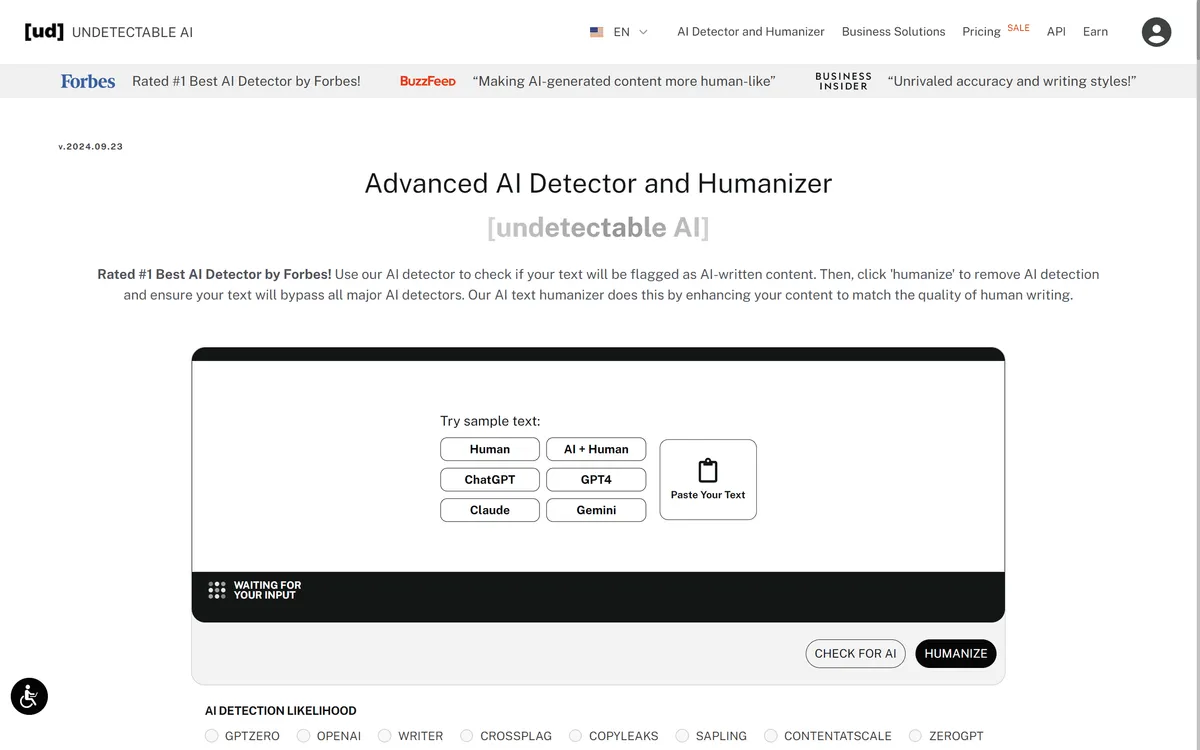
At its core, Undetectable.ai runs a free AI detector and a paid rewriter. The detector accepts pasted text or file uploads up to 10,000 words per check, requires no signup, and returns an instant read on whether the content resembles output from models such as ChatGPT, GPT-5, Claude, Gemini, Llama, or DeepSeek. The vendor states that submissions are not stored or used to train models, which matters if you are checking material you would rather not leave on a third-party server. There is also a separate AI image detector, though the writing tools are the reason most people arrive.
The humanizer is the commercial half. You feed it AI-generated text, and it rewrites the passage to preserve the original meaning while shifting the phrasing, rhythm, and word choices that detection systems tend to flag. The company frames this as checking compatibility with detectors including Originality.ai, GPTZero, Writer.com, and Copyleaks rather than promising to defeat them outright, which is a more honest framing than some competitors use, even if the practical intent is the same.
The features that carry the workflow
A few capabilities do the heavy lifting. The first is the combined detect-then-rewrite loop: because the detector and humanizer live in the same product, you can rewrite a passage and immediately re-check it without copying text between separate services. That tight feedback cycle is genuinely useful when you are iterating on a stubborn paragraph, and it is the main argument for using an integrated tool rather than stitching together a free detector and a general-purpose rewriter.
Writing-level matching is the second. Rather than flattening everything to one generic register, the humanizer aims to keep the output consistent with the intended reading level, which is what separates usable rewrites from text that reads as scrambled. For anyone producing content for a specific audience, this is the difference between output you can lightly edit and output you have to rebuild.
The remaining features broaden the reach rather than deepen the core. Multi-language support spans more than 50 languages, with the vendor noting that accuracy is highest in English, so expect the rewriter to be strongest on English text and to soften as you move into less-resourced languages. Bulk and file-upload handling lets you process longer documents in one pass rather than pasting fragments. A Chrome extension brings detection into the browser for checking text where you find it. And API access, offered on every paid tier, is the piece that turns the product from a manual tool into something you can wire into a publishing or content-review pipeline.
How much to expect from the AI layer
This is where an honest review has to slow down. Undetectable.ai advertises strong numbers: it cites being named a top AI detector by Forbes, claims 99%-plus accuracy from independent studies, and references peer-reviewed research reporting full detection with no false positives. Those are the vendor's claims, and they concern the detector, not a guarantee about the humanizer.
The realistic expectation is that detection is a moving target. AI models change, detection systems retrain, and any given detector's verdict is a probability estimate rather than a fact. A rewrite that reads as human to one detector today may not clear a different detector, or the same detector after an update. Treat a passing score as a snapshot, not a certificate. The tool is most valuable as an editing aid that surfaces the passages a reader might find robotic and helps you smooth them, and least reliable if you are counting on it to permanently outrun institutional checks. Anyone using it in an academic or professional setting where AI assistance is prohibited should understand that the risk does not disappear because a meter turned green, and that the ethical and policy questions sit outside what any software can resolve.
Using it day to day
The detector's no-signup, instant-result design lowers the barrier to a quick check, and the 10,000-word ceiling per check is generous enough for most single documents. The paste-check-rewrite-recheck rhythm is straightforward, and the browser extension removes friction for spot-checking. The main usability caveat is the free trial on the paid side: the humanizer trial is capped at 250 words, which is enough to judge tone and quality on a sample but not enough to run a real project, so evaluating the tool properly means committing to a paid month.
What it costs
Pricing is built around monthly word credits, and the entry point is low. The published tiers are:
| Plan | Monthly | Annual (per month) |
|---|---|---|
| 10,000 words/month | $9.99 | $5.00 (billed $60/yr) |
| 20,000 words/month | $19.00 | $9.50 (billed $114/yr) |
| 35,000 words/month | $31.00 | $15.75 (billed $189/yr) |
All paid tiers include the same feature set: detector passing, writing-level matching, watermark protection, API access, and unlimited detection. Annual billing roughly halves the effective monthly rate, and the vendor promotes a "6 months free" framing on annual plans, so the discount is real but assumes you are confident enough to pay a year up front. Above 35,000 words there are custom plans that add non-expiring credits plus redistribution and white-labeling, and a business tier that requires contacting sales and bundles priority support. The word-credit model is the number to watch: if your volume is unpredictable, the entry plan can run dry quickly, and the jump to higher tiers is where the monthly cost stops feeling incidental.
Where it fits and who should look elsewhere
Undetectable.ai makes the most sense for content marketers, bloggers, and SEO writers who draft with AI and want copy that reads naturally before it goes to a client or editor. The integrated detect-and-rewrite loop, low entry price, and API access make it a reasonable fit for that use, and the free detector alone is worth bookmarking as a sanity check. It is a weaker fit for anyone in a context where AI use is formally restricted, for teams that need guaranteed outcomes rather than probability-based ones, and for writers working primarily in languages far from English, where quality will be less predictable. If you want to compare options in this category, the broader AI writing assistant listings are a useful starting point, and you can browse the full tools directory for adjacent detection and editing products.
Common questions
Is Undetectable.ai free to use?
The AI detector is fully free and needs no signup, accepting up to 10,000 words per check. The humanizer offers only a limited trial of 250 words; beyond that it requires a paid plan.
How much does the humanizer cost?
Paid plans start at $9.99 per month for 10,000 words, with 20,000-word and 35,000-word tiers at $19 and $31 monthly. Annual billing lowers the effective rate to $5, $9.50, and $15.75 per month respectively.
Which AI detectors does it check against?
The vendor lists compatibility with Originality.ai, GPTZero, Writer.com, and Copyleaks, and its own detector identifies output from models including ChatGPT, GPT-5, Claude, Gemini, Llama, and DeepSeek.
Does it work in languages other than English?
It supports more than 50 languages, though the company states accuracy is highest in English, so results outside English are likely to be less consistent.
Can developers integrate it into their own systems?
Yes. API access is included on every paid tier, which allows the detection and humanizing features to be built into publishing or content-review workflows.