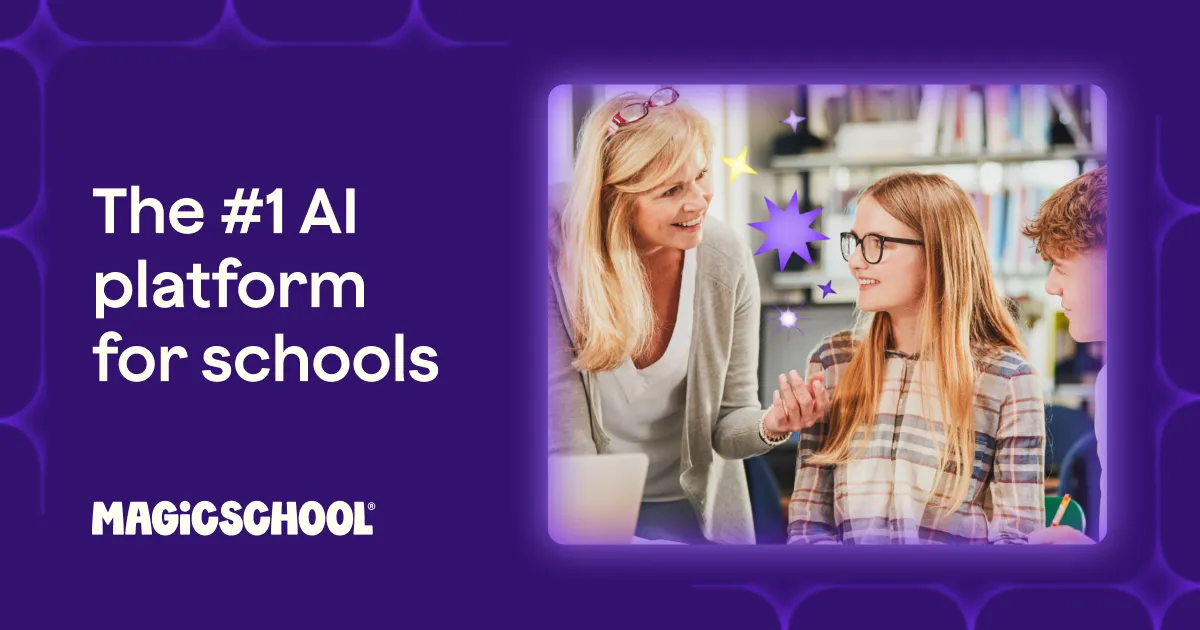

If you are evaluating this tool, here is what matters. MagicSchool AI is not a general-purpose chatbot with a school logo pasted on. It is a task-oriented layer over a large language model, organized around the specific documents and interactions that fill a teacher's week: lesson plans, rubrics, quizzes, report card comments, parent emails, and IEP drafts. The value proposition is narrow and honest, and it reduces the friction of prompting. Instead of learning how to coax a generic model into producing a usable rubric, you open a purpose-built form, answer a few structured fields, and get output that is already shaped for the classroom.
What you actually get
The platform advertises more than 80 teacher tools and more than 50 student tools. In practice these are guided generators. The lesson plan generator, presentation generator, multiple-choice quiz builder, rubric generator, text rewriter, report card comment writer, and professional email drafter all follow the same pattern: a small intake form that constrains the model toward a specific output type. This is the part worth understanding, because it explains both the appeal and the ceiling. The forms remove the blank-page problem and standardize quality, but they also mean you are working inside someone else's idea of what a lesson plan should contain.
Two tools stand out for their institutional weight. The IEP generator targets special-education documentation, which is among the most time-consuming and legally sensitive writing a teacher produces. Used as a drafting aid rather than a final authority, it can meaningfully cut the hours spent on goal wording and boilerplate. The writing feedback and text rewriter tools support differentiation, letting a teacher adapt one passage to several reading levels without rewriting each version by hand. That is a real workload lever for mixed-ability classrooms.
On the student side, the platform includes Raina, an AI tutor, plus teacher-led activities and student learning insights. The framing here is supervised use: students interact with AI inside a teacher-directed context rather than an open chat window. MagicSchool also supports integrations with Google (Docs and Classroom), Canvas, Schoology, Clever, ClassLink, and Microsoft, which matters if you want AI outputs to land where your class already lives instead of in a separate silo.
The compliance posture is more developed than most consumer AI tools. The vendor states it is SOC 2 certified and FERPA, COPPA, CCPA, and GDPR compliant, is Common Sense Privacy Verified and TrustEd Apps Certified, and does not use student or teacher data to train its AI. For any school procurement conversation, that last claim is the one that unblocks adoption.
Where it earns its place
The strongest case for MagicSchool is repetitive, formulaic writing that a teacher must produce but that carries little pedagogical creativity: report card comments across thirty students, a first draft of a parent email, a rubric aligned to an objective, a differentiated version of an existing reading. The structured forms genuinely lower the cognitive cost of these tasks, and the education-specific framing means you spend less time correcting a general model's wrong assumptions about grade level and tone. The integrations reduce copy-paste friction, and the supervised student tools give teachers a defensible way to introduce AI to a class without opening an unmonitored chatbot. The vendor publishes outcome figures such as seven to ten hours saved per week; treat those as marketing-sourced rather than independently verified, but the underlying mechanism (offloading first drafts) is real.
The limits worth knowing before you commit
The same structure that makes the tool approachable also caps it. Because each tool is a constrained form, you have less control than you would prompting a raw model directly, and power users who already know how to prompt well may find the guardrails limiting. Output quality inherits every weakness of the underlying language model: factual drift, generic phrasing, and confident errors, none of which the education wrapper eliminates. IEP and assessment content in particular should never ship without a qualified human reviewing it, and the platform's convenience can tempt overworked staff into rubber-stamping drafts. There is also a genuine pedagogical question the vendor cannot answer for you: how much lesson design you want to delegate. A rubric the tool generates is a rubric you did not think through yourself, and that tradeoff is a professional judgment, not a feature toggle.
Pricing reality
MagicSchool uses three tiers, and the free plan is unusually complete rather than a crippled teaser.
| Plan | Price | What it adds |
|---|---|---|
| Free | $0, described as forever free | 80+ teacher tools, 50+ student tools, Raina chatbot, quizzes, class writing feedback, student learning insights, basic support |
| Plus | $8.33/user/month billed annually ($99.96/year) or $12.99/month monthly | Unlimited generations, unlimited output history, unlimited AI-output editing, advanced tool features, Labs early access |
| Enterprise | Custom quote | Custom data privacy agreement, SIS/LMS integrations, single sign-on, tool customization, advanced safeguards, data dashboards, dedicated customer success manager, onboarding |
The honest read: an individual teacher can run on the free plan for a long time, and the main thing Plus buys is the removal of usage caps and history limits plus editing conveniences. If you generate content only occasionally, paying is hard to justify. Enterprise is where the meaningful institutional features live, single sign-on, data dashboards, and a custom privacy agreement, but the vendor does not publish per-seat or per-school pricing, so a district cannot budget without contacting sales. That opacity is normal for education procurement but worth flagging.
How it compares to the alternatives
The most obvious alternative is a general-purpose assistant used directly, which gives you unlimited flexibility and no education-specific guardrails, at the cost of doing your own prompt engineering and vetting the data-privacy terms yourself. That path is cheaper and more powerful in raw capability but weaker on compliance framing and on the supervised student experience. Many learning management systems are also adding their own AI features, so before adopting a separate platform, check whether the tools you already pay for cover the same ground. If your primary need is a single document type rather than a broad suite, a narrower specialist tool may fit better. You can compare options in the AI writing assistant category or browse the wider tool directory to see where MagicSchool sits against neighbors.
Final verdict
MagicSchool AI is a well-scoped, education-first productivity layer that does a specific job well: turning recurring teacher paperwork into structured, first-draft output while keeping student interactions supervised and the compliance story clean. Its ceiling is set by the same structure that makes it easy, and none of it removes the teacher's obligation to review what the model produces, especially for IEPs and assessments. For a K-12 teacher who wants time back on formulaic tasks, the free plan is a low-risk trial and Plus is a modest upgrade. For a district, the value is in Enterprise governance, but you will have to talk to sales to price it. Readers who want deeper AI-in-education context can find related writing on the blog.
Common questions about MagicSchool AI
Is MagicSchool AI actually free?
Yes. The vendor offers a free plan described as forever free that includes the full set of 80+ teacher tools, 50+ student tools, the Raina chatbot, quizzes, and student learning insights. The paid Plus tier mainly removes usage and history caps rather than unlocking the core tools.
What does the Plus plan add over the free plan?
Plus adds unlimited generations, unlimited output history, unlimited editing of AI output, advanced tool features, and early access to MagicSchool Labs. It costs $8.33 per user per month billed annually ($99.96 per year) or $12.99 per month billed monthly.
Does MagicSchool integrate with my existing classroom tools?
The site lists integrations with Google (Docs and Classroom), Canvas, Schoology, Clever, ClassLink, and Microsoft. Single sign-on and broader SIS/LMS integration are part of the Enterprise tier rather than the free or Plus plans.
Is it safe to use student data with MagicSchool?
The vendor states it is SOC 2 certified and FERPA, COPPA, CCPA, and GDPR compliant, is Common Sense Privacy Verified and TrustEd Apps Certified, and does not use student or teacher data to train its AI. Districts can also negotiate a custom data privacy agreement under the Enterprise plan.
Can I trust the lesson plans and IEPs it generates?
Treat all output as a first draft. The tools are structured generators built on a language model, so they speed up writing but do not guarantee accuracy. IEP and assessment content in particular should be reviewed by a qualified educator before use.