

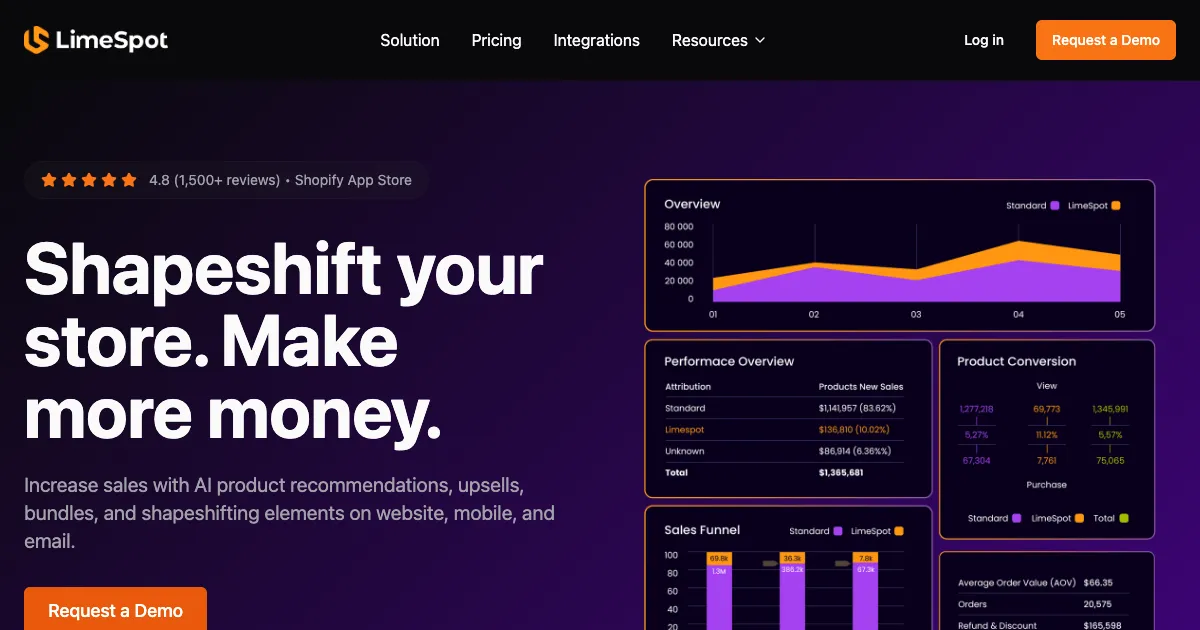

The practical promise behind LimeSpot is straightforward: it decides which products to show each shopper, and where, so that a store earns more per visit without a merchandiser manually curating every page. It watches browsing and purchase behavior in real time and places recommendation blocks, upsells, and cross-sells at the points in a session where they are most likely to move an order. For a store owner, that is the difference between hard-coding a "You may also like" row once and having an engine that keeps adjusting what appears there.
The platform is built specifically for two ecommerce stacks. LimeSpot runs on Shopify and BigCommerce, and it is not positioned as a general-purpose tool you bolt onto any site. That focus is worth understanding before you evaluate it, because it shapes both the depth of the integration and the ceiling on where it can be used. According to the vendor, the company has operated since 2013 and holds a 4.8-star rating across more than 1,500 Shopify reviews, with usage claimed across roughly 135 countries.
What the engine actually does, and when each piece earns its keep
Rather than list capabilities in the abstract, it helps to pair each feature with the moment it is meant to affect and the tradeoff involved.
- Real-time product recommendations — The core of the product. Because the recommendations respond to behavior within a session, they matter most on stores with a deep or frequently changing catalog, where hand-picking related items across hundreds of SKUs is impractical. On a store with a dozen products, the automation has less to work with and the lift will be smaller.
- Upsells and cross-sells — These target the cart and product page, where the shopper has already signaled intent. The benefit is a higher average order value from traffic you already paid to acquire. The tradeoff is presentation discipline: aggressive upsell placement can add friction, so this is a feature to test rather than max out.
- Customer segmentation — Behavioral tracking groups shoppers by how they browse and buy. This matters when different audiences respond to different merchandising, for example new visitors versus repeat buyers. If your catalog and audience are homogeneous, the segmentation adds less.
- Email and SMS with dynamic content — Recommendations follow the shopper off-site into campaigns. The value here is continuity: the products a person looked at can populate a follow-up message automatically. This is most useful for stores already running lifecycle messaging and looking to make it personalized without building the logic themselves.
- Content personalization — Beyond product rows, the platform can vary images, collections, and text by visitor. This is a heavier lift to configure and pays off mainly for merchants who have distinct segments worth showing genuinely different storefront content.
- A/B testing and analytics — The reason this belongs in any serious evaluation: personalization that you cannot measure is a leap of faith. Built-in testing lets you compare placements and strategies, and the analytics are meant to attribute revenue lift to specific recommendations. Use this from day one, because the honest way to judge the tool is against your own baseline, not the vendor's example numbers.
A note on the results LimeSpot publishes. The site cites figures such as conversion improvements ranging from 2.3% to 24.7% and a product-page case study of +14.5% conversion. Treat these as illustrative of what is possible, not as a forecast for your store. The wide range is itself the tell: outcomes depend on your traffic volume, catalog depth, and how disciplined you are about testing.
Integrations and reach
Personalization only helps if it plugs into the rest of your stack. LimeSpot states it connects with Klaviyo, Google Ads, and 50 or more other platforms. The Klaviyo tie-in is the one most merchants will care about, since it is what makes personalized recommendation blocks inside email campaigns practical rather than manual. The vendor also states the platform is GDPR compliant, which is relevant if you sell into the EU and need to account for how shopper behavior is tracked.
Where it fits in a real store
The clearest use case is a mid-sized Shopify or BigCommerce catalog with enough SKUs that manual related-product curation has become a chore, and enough traffic that small percentage lifts translate into real money. A store running paid acquisition benefits most, because raising average order value and revenue per visitor improves the return on ad spend you are already committed to. Merchants who already send lifecycle email through Klaviyo can extend that investment by making the content dynamic.
It is a weaker fit for very small stores, single-product brands, or catalogs too shallow for recommendations to have meaningful choices. It is also not an option for merchants on platforms other than Shopify and BigCommerce, since those are the only two the vendor supports. If your bottleneck is traffic rather than conversion, a personalization layer will not fix the underlying problem. You can compare it against other tools in business and productivity AI before committing.
Pricing
LimeSpot's published pricing centers on a plan called LimeSpot Max, listed at $150 per month for stores doing up to $50,000 in revenue per 30 days from the online store channel, with pricing tiered upward as revenue grows. That revenue-based model is common for this category and has an obvious logic: the cost scales with the sales the tool is meant to influence. The vendor advertises a 15-day free trial, no setup fees, the ability to cancel anytime, and at the time of writing a 50% lifetime discount for new sign-ups.
One point to flag for anyone comparing sources: while some third-party summaries describe a permanently free plan, the vendor's own pricing page presents a free trial rather than a standing free tier. If a no-cost plan matters to your decision, confirm the current terms directly with LimeSpot, since the published plan is paid after the trial.
| Plan | Price | Revenue covered | Trial |
|---|---|---|---|
| LimeSpot Max | $150 / month | Up to $50,000 per 30 days (online store channel), tiered above | 15-day free trial |
Common questions
Which ecommerce platforms does LimeSpot support?
The vendor supports Shopify and BigCommerce. It is not documented as a solution for other platforms, so merchants on Magento, WooCommerce, or custom storefronts would need to look elsewhere.
Is there a free plan?
The pricing page shows a 15-day free trial rather than a permanent free plan, with no setup fees and cancel-anytime terms. The paid plan, LimeSpot Max, starts at $150 per month for stores up to $50,000 in 30-day revenue.
Does it work with email marketing tools?
Yes. LimeSpot integrates with Klaviyo, Google Ads, and, per the vendor, 50 or more other platforms, and it can place dynamic recommendation content inside email and SMS campaigns.
How is pricing structured?
Pricing is tiered by store revenue. The entry paid plan covers up to $50,000 in revenue per 30 days from the online store channel and increases as that revenue grows, so cost scales with the sales the tool influences.
Can I measure whether it actually works?
The platform includes A/B testing and analytics intended to attribute revenue lift to specific recommendation placements, which is the practical way to judge the tool against your own store's baseline. You can browse related options in the tools directory if you want to benchmark alternatives.