


What Synthesis AI Is
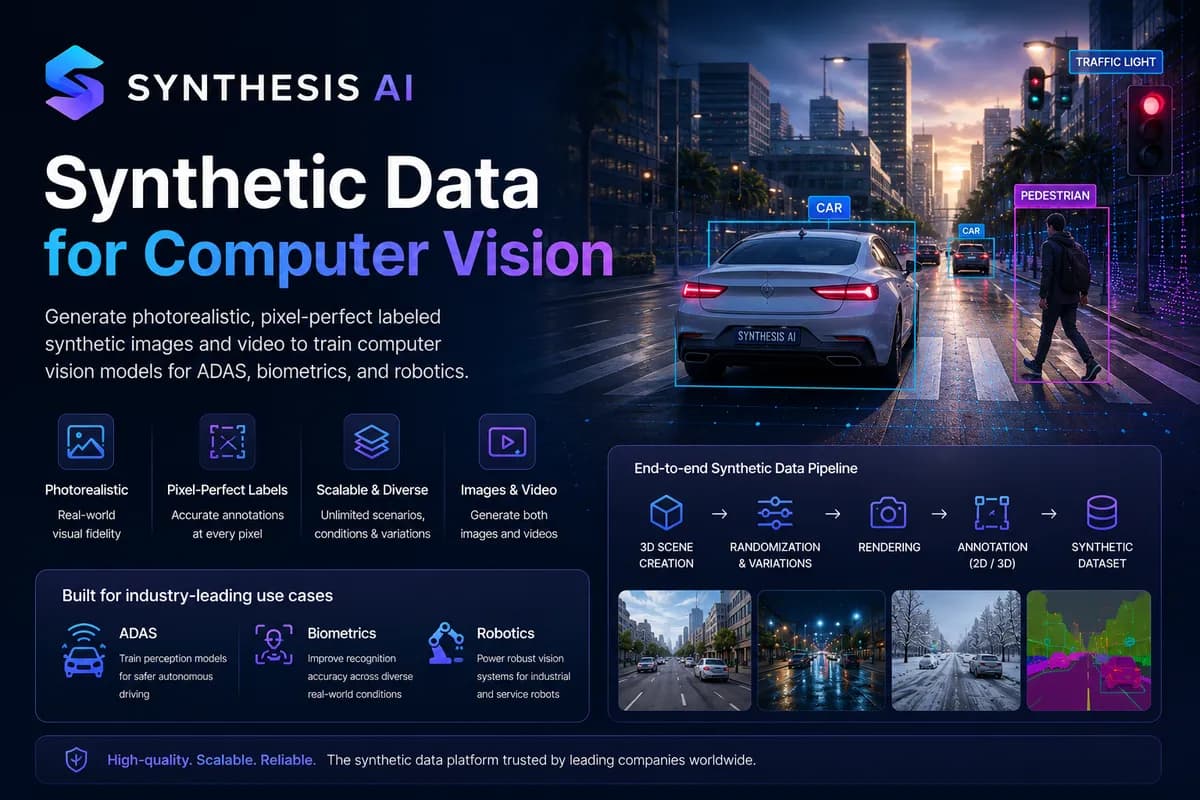
Training a computer vision model is hungry work. It needs thousands or millions of labeled images covering every face, pose, lighting condition, and edge case the model might meet in the real world. Collecting and hand-labeling that data is slow, expensive, and raises privacy headaches when real people are involved. Synthesis AI tackles that bottleneck by generating the data instead of gathering it. The platform produces photorealistic synthetic images and video, rendered by computer, with annotations baked in from the start.
Because the imagery is generated rather than photographed, every pixel is already labeled and the dataset is privacy-compliant by design. There is no real person to consent or anonymize. That combination of scale, accuracy, and privacy is the core pitch for teams building perception AI.
How It Works
Synthesis AI couples generative AI with cinematic CGI rendering pipelines. Rather than asking a model to dream up an image and hoping it is correct, the platform builds 3D scenes and renders them with controllable parameters, then layers generative techniques on top for variety and realism. The result is on-demand generation of diverse, photorealistic, pixel-perfect labeled images and video. Need a million faces across a wide spread of demographics, expressions, and environments? You specify the attributes and the platform synthesizes them, complete with detailed annotations such as segmentation masks, landmarks, and depth.
Standout Capabilities
Digital Human Synthesis
A signature strength is high-resolution 3D digital human generation, including text-to-3D approaches for creating people. You can control attributes like skin tone, facial features, expression, and clothing, which lets teams build balanced, representative datasets instead of inheriting the bias of whatever real photos they happened to scrape.
Pixel-Perfect Labeling
Every synthetic image arrives with exact annotations because the system knows the ground truth of the scene it rendered. This removes the labeling error and cost that plague manually annotated datasets.
Controllable Diversity At Scale
The platform generates millions of images spanning demographics, lighting, camera angles, and environments. That breadth is what helps models generalize and handle rare edge cases that are hard to capture in real footage.
Faster Iteration For ML Teams
Because data is generated on demand, teams can spin up a fresh dataset when they discover a gap, rather than waiting weeks for a new collection campaign. If a model keeps failing on low-light scenes or a particular head pose, you generate more of exactly that and retrain. This tight loop between finding a weakness and fixing it is hard to match with real-world capture, where you cannot always stage the scenario you need.
Why Teams Choose Synthetic Data
The case for synthetic data comes down to three pressures that real-world collection struggles with: cost, privacy, and balance. Photographing and hand-labeling millions of images is expensive and error-prone, and human annotators disagree on edge cases. Using real faces and personal footage raises consent and regulatory questions under rules like GDPR. And scraped or collected datasets often carry hidden demographic skew that bakes bias into a model. Synthetic generation answers all three at once. The data is cheaper to produce at scale, contains no real individuals to protect, and can be deliberately balanced across demographics and conditions so the trained model behaves fairly. For perception systems where a missed detection has real consequences, that controllability is the deciding factor.
Who It Is For And Use Cases
Synthesis AI serves machine learning and computer vision teams across several industries. In automotive it supports ADAS and driver-monitoring systems. In biometrics and security it feeds face recognition and liveness detection. Consumer electronics teams use it for camera and on-device vision features, while healthcare, robotics, and retail apply it to perception tasks ranging from patient monitoring to warehouse automation. It also strengthens AR and VR experiences that depend on understanding faces and bodies. The common thread is any team that needs large, diverse, accurately labeled training data without the cost and privacy risk of real-world collection.
Pricing
Synthesis AI is an enterprise, project-oriented platform rather than a self-serve app with a public price list. Synthetic data engagements are typically scoped to the volume, modality, and customization a customer needs, so pricing is generally arranged with the team. For current details and to discuss a dataset, it is best to contact Synthesis AI directly through their site.
Verdict
Synthesis AI addresses a real and expensive problem in computer vision: getting enough good, labeled, privacy-safe data. Its mix of CGI rendering and generative AI, plus deep strength in digital humans, makes it a strong fit for perception teams in automotive, biometrics, and robotics. It is built for serious ML organizations rather than casual users, but for the teams it targets, synthetic data can meaningfully cut the time and risk of building a training set from scratch.