


A teacher opens a batch of thirty essays the night before grades are due, and three of them read too clean, too even, too devoid of the small stumbles that mark a first draft. She can't prove anything, and accusing a student on a hunch is a fast way to end up in a difficult meeting with a parent and a principal. This is the exact situation GPTZero was built for: turning a vague suspicion into something more structured, whether or not that structure ends in an accusation.
What GPTZero Actually Does
GPTZero is an AI content detector that estimates the probability a piece of text was produced by a large language model rather than a person. It targets output from the models people actually paste into assignments and articles: ChatGPT, GPT-5, GPT-4, GPT-3, Google's Gemini, Anthropic's Claude, Meta's Llama, and Deepseek, plus tools built on top of those models. The project began in 2023 with Princeton student Edward Tian and has since grown into a platform the vendor says is trusted by over 10 million teachers and students.
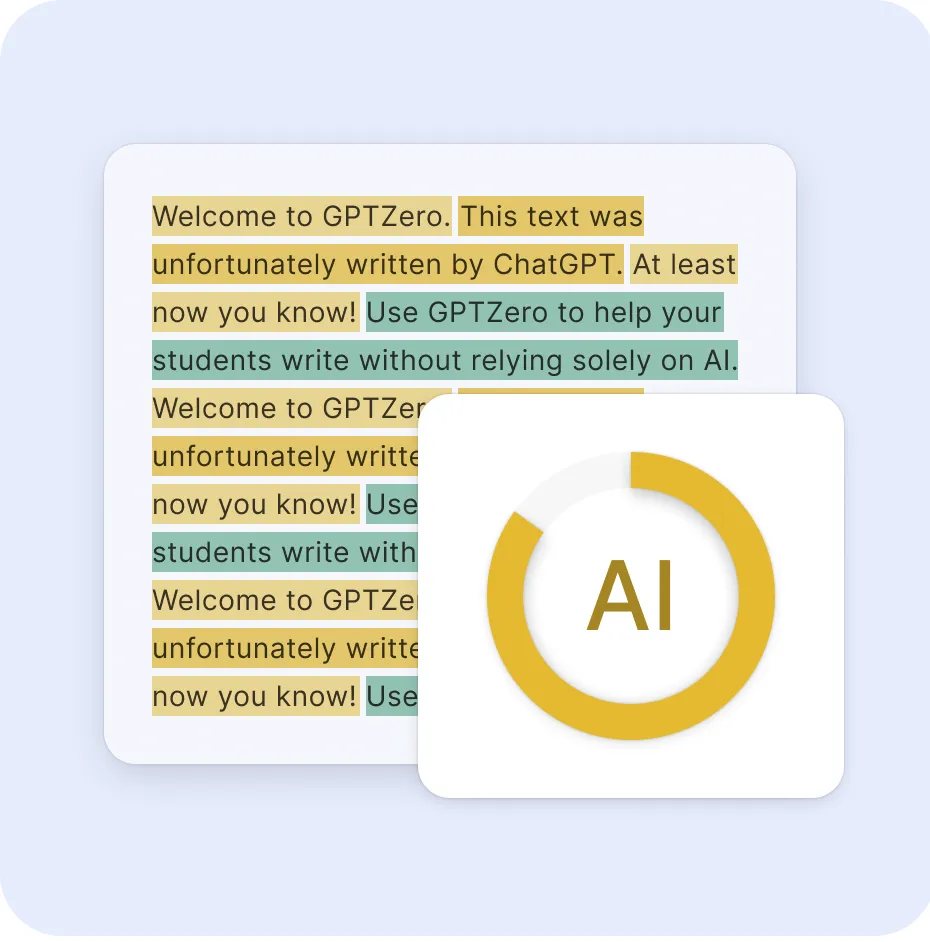
The underlying idea is that machine-written prose tends to be statistically smoother than human writing. GPTZero looks at signals in that vein and returns not just a verdict but sentence-level, color-coded highlighting of the passages it considers AI-generated. That granularity matters more than a single percentage score, because a mixed document, part human, part pasted from a chatbot, is far more common than a fully synthetic one, and a top-line number hides that nuance.
Who Should Consider It
The clearest fit is anyone whose job involves judging the origin of written work at scale. That means classroom teachers and university faculty, but the vendor also points at recruiters screening application materials, publishers and content platforms guarding editorial standards, and legal and cybersecurity teams reviewing documents. If you write and simply want to check whether your own drafts read as machine-like before you hand them in, the tool works for that too, though that is a secondary use.
It is a poorer fit for anyone who needs a definitive, defensible ruling. No AI detector, GPTZero included, produces evidence in the courtroom sense. If your process treats a detection score as an automatic verdict rather than a prompt to investigate, you will eventually punish an innocent writer, and the tool cannot protect you from that decision.
The Features That Carry the Product
The sentence-level highlighting is the feature most worth understanding. Instead of a blunt document-wide score, it flags specific sentences, which lets a reviewer see whether a suspicious result comes from one pasted paragraph or is spread throughout. That is what makes a follow-up conversation with a student possible rather than accusatory guesswork.
The Writing Report is GPTZero's more interesting answer to the detection problem. Rather than judging only the finished text, it can incorporate a replay of the writing process and human-writing verification, evidence that a document was typed and revised over time rather than pasted in one motion. Process evidence is harder to fake than a clean final draft and sidesteps the core weakness of pure statistical detection, so for high-stakes academic cases this is arguably the more trustworthy signal.
Around those two anchors sit several supporting tools. A Hallucination Detector looks for fabricated citations and fake academic sources, which is a genuinely useful check given how confidently chatbots invent references. There is a plagiarism checker for copied external content, a grammar checker, an AI Vocabulary tool that surfaces words statistically overused by AI models, and an AI Reviewer that offers grading-style feedback. These broaden GPTZero from a single-purpose detector toward a wider authorship and integrity workstation, though the detection engine remains the reason most people arrive.
For volume users, batch scanning handles many documents at once, and an API lets institutions wire detection directly into their own systems. Integrations are the practical differentiator here: a Chrome extension, Google Docs, Google Classroom, Canvas, and Zapier mean a teacher can check work inside the grading tools they already use rather than copy-pasting into a separate tab. For an LMS-centric school, native Canvas and Google Classroom support is often what decides adoption.
How People Put It to Work
- Academic integrity screening: faculty run submitted essays and flag passages for a follow-up conversation, using the Writing Report as corroboration rather than relying on the score alone.
- Editorial vetting: publishers and content platforms check freelance or contributor submissions against a human-authorship standard before publishing.
- Citation verification: researchers and editors use the Hallucination Detector to catch invented sources before they reach print.
- Hiring and recruiting: teams review cover letters and written assessments for signs of wholesale AI generation.
- Self-checking: writers scan their own drafts to gauge how machine-like their prose reads, and to catch overused AI vocabulary.
You can browse comparable options among other AI writing assistant tools if detection is only one part of a broader workflow you are assembling.
Accuracy Claims, Read Carefully
GPTZero publishes strong numbers: a stated 99% accuracy rate for separating AI from human writing, 95.7% detection of AI texts, 96.5% accuracy on mixed documents, and a claim to be the most accurate detector by independent benchmarks. These figures come from the vendor's own site, and it is worth being clear-eyed about them. Detection accuracy depends heavily on the test set, the models being detected, and how much a writer has edited machine output. Lightly paraphrased or human-revised AI text is the known blind spot for every detector in this space, and there is an equally documented risk of false positives on genuine human writing, particularly from non-native English writers whose prose can read as statistically "flat." Treat the headline percentages as best-case conditions, not a guarantee for your specific documents.
Pricing
GPTZero uses a freemium model. The free tier lets you scan up to 10,000 characters without creating an account, which is enough to test a single essay or article and decide whether the tool fits your workflow. Larger scans require an account, and paid access is organized around a Professional plan, with separate Enterprise and Team plans that require contacting sales. The site advertises an annual billing option described as saving 45% over monthly. The vendor does not publish the exact dollar figures for each tier on the page I reviewed, so confirm current prices and per-plan word or character limits on the official pricing page before budgeting, especially for institution-wide licensing where the sales-led Team and Enterprise tiers apply.
Where It Falls Short
The central limitation is inherent to the category rather than to GPTZero specifically: probabilistic detection cannot deliver certainty, and any institution that forgets this invites unfair outcomes. False positives on legitimate human writing are a real and studied phenomenon, and a well-edited piece of AI text can slip past. The Writing Report mitigates this for supervised assignments but not for work submitted as a finished file with no process history.
The second issue is transparency around cost. Because concrete pricing and per-tier limits are not documented on the public pricing page in a way that a quick fetch can capture, buyers cannot easily compare tiers without engaging the product or sales team, which slows evaluation for smaller departments. Finally, the expanding feature set, grammar checking, plagiarism, reviewing, adds surface area that overlaps with dedicated tools you may already pay for; whether that consolidation is a benefit or redundant spend depends on your existing stack.
The Verdict
GPTZero is a credible, mature option in AI text detection, and its emphasis on sentence-level highlighting, process-based Writing Reports, and native integrations with Canvas, Google Classroom, and Google Docs makes it particularly sensible for schools. The Hallucination Detector and API give it reach beyond the classroom into editorial and enterprise contexts. The right mental model is a detector that produces well-organized suspicion, not proof. Used that way, as the first step in a human review process, it earns its place; used as an automatic judge, it will eventually let you down. Try the free 10,000-character scan on writing whose origin you already know before you trust it on writing you don't. For broader context on evaluating AI tools, our blog covers related workflows.
Common Questions
Which AI models can GPTZero detect?
According to the vendor, GPTZero detects text from ChatGPT, GPT-5, GPT-4, GPT-3, Google Gemini, Anthropic's Claude, Meta's Llama, and Deepseek, along with services built on those models.
Can I use GPTZero without paying or creating an account?
Yes. There is a free tier that lets you scan up to 10,000 characters without an account. Larger scans require creating an account, and full features sit behind the paid Professional, Team, and Enterprise plans.
Does GPTZero integrate with the tools teachers already use?
It offers a Chrome extension plus integrations with Google Docs, Google Classroom, and Canvas, along with Zapier and an API for developers, so detection can run inside existing grading and LMS environments.
How accurate is GPTZero?
The vendor cites a 99% accuracy rate distinguishing AI from human writing, 95.7% detection of AI texts, and 96.5% on mixed documents. These are vendor-published figures under favorable conditions; edited AI text and some genuine human writing can produce incorrect results, so the score should inform a human review rather than replace it.
What is the Writing Report and why does it matter?
The Writing Report can include a replay of how a document was written and human-writing verification, showing that text was typed and revised over time rather than pasted at once. Because process history is harder to fake than a polished final draft, it is often more trustworthy than a raw detection score for high-stakes cases.