

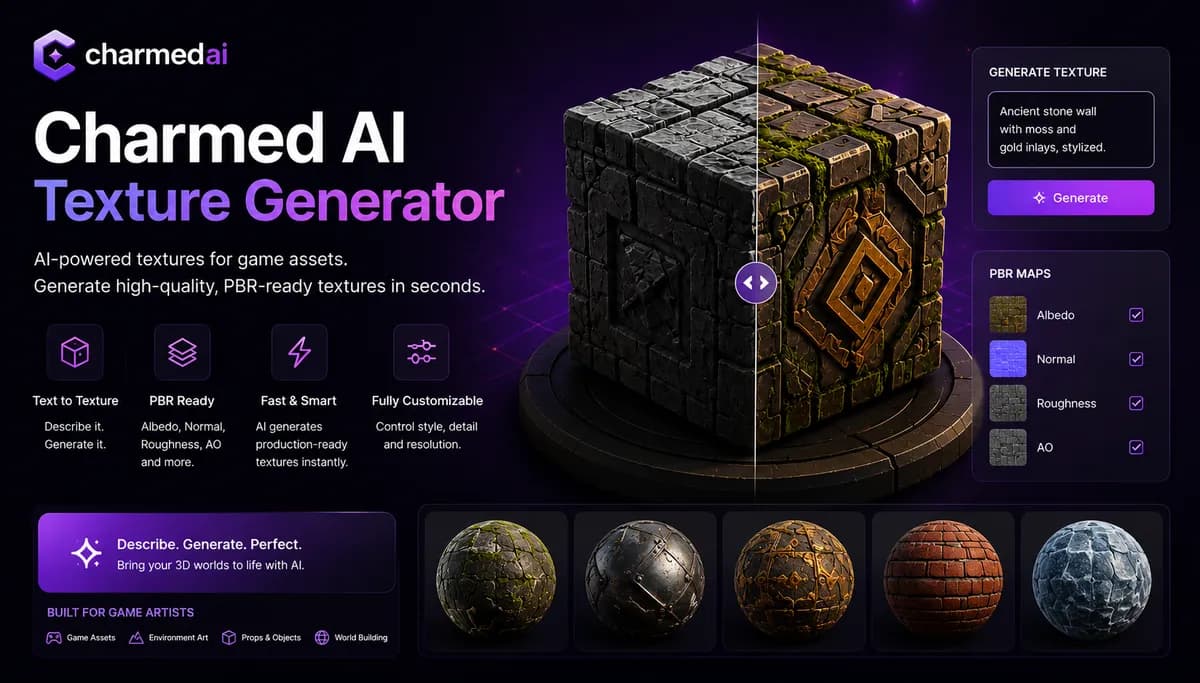

What Charmed AI was
Charmed AI was an end-to-end AI toolkit aimed at 3D game art creation. Rather than focusing on one trick, it bundled several stages of the asset pipeline into a single platform: generating meshes, producing textures, rigging and animating characters, and even building out game worlds. It was designed to let artists and small studios move faster through the parts of 3D production that are slow and repetitive.
Before going further, an important note: Charmed AI has shut down. Asset generation stopped being available on April 18, 2025, and May 16, 2025 was the final day for existing users to download their assets. The toolkit is no longer operational, so this profile is a record of what it offered rather than a recommendation to sign up. If you are looking for similar capabilities today, you will need a current alternative.
How it fit into a 3D workflow
The toolkit covered multiple stages so an artist could go from concept toward a usable, rigged, textured asset without bouncing between several separate apps. You could generate a base mesh, give it PBR textures, auto-rig a character for animation, and assemble environments, all under one roof. That consolidation was the main draw for game artists who normally stitch together a chain of specialized tools.
What it offered
Texture generator
The Texture Generator produced high-quality, UV-unwrapped textures, including PBR materials. UV unwrapping is a tedious manual step in normal workflows, so automating it alongside texture creation removed a real bottleneck for asset artists.
Geometry generator
The Geometry Generator created 3D meshes along with initial textures, giving artists a starting model to refine rather than building topology from a blank scene.
3D animator and auto-rigging
The 3D Animator could auto-rig T-posed character meshes and retarget animations onto them. Rigging is one of the more technical, time-consuming parts of character production, so automating it widened who could get a character moving.
Worldbuilding tools
Beyond single assets, Charmed included a Quest Generator for worldbuilding and a Dungeon Generator for creating isometric tilemaps. These pushed it past asset creation toward helping design playable spaces.
Why the all-in-one approach mattered
Most AI 3D tools at the time solved a single slice of the problem: one app for textures, another for meshes, a separate service for rigging. The friction was in moving assets between them, matching coordinate systems, and re-doing UVs at each handoff. Charmed AI tried to collapse that into a single environment where a mesh you generated could be textured and rigged without leaving the toolkit. For a solo developer or a tiny team, that consolidation was the real value, because it removed the constant context-switching that eats up production time.
The texture side leaned on PBR materials, which is what modern engines like Unity and Unreal expect, so assets came out with a workflow-appropriate material setup rather than flat color maps. Pairing automatic UV unwrapping with that texture generation was the standout, since UV work is one of the least-loved manual chores in 3D and a frequent reason artists avoid making their own assets.
Who it was for
Charmed AI targeted indie game developers, 3D artists, and small studios who needed to produce game-ready assets without a full pipeline of specialized hires. The combination of mesh, texture, rigging, and worldbuilding tools made it especially appealing to solo developers wearing many hats. Its strength was breadth across the pipeline; as with any automated 3D tooling, output typically needed an artist pass before shipping in a polished game.
Lessons for choosing a replacement
If you came here looking for Charmed and need to move on, its feature list is a useful checklist. Decide which stages you actually relied on, whether that was texture generation with UV unwrapping, mesh creation, auto-rigging, or worldbuilding generators, and weigh alternatives against those specific needs rather than chasing a single all-in-one promise. Few current tools cover the entire pipeline as broadly, so you may end up combining two or three specialized services. Prioritize PBR-correct texture output and clean, riggable topology if your work is engine-bound.
Pricing and current status
Specific pricing tiers are no longer publicly maintained, and since the platform has closed, signing up is not possible. The most important fact for anyone researching it now is the shutdown timeline: generation ended April 18, 2025, and asset downloads closed May 16, 2025. If you previously used Charmed, your assets should have been retrieved before that final date.
Verdict
Charmed AI was an ambitious, genuinely broad attempt to compress the 3D game-art pipeline into one AI toolkit, and its mix of texture generation with automatic UV unwrapping, mesh creation, auto-rigging, and worldbuilding generators was more complete than most single-purpose competitors. It earned a following among 3D artists for streamlining tedious steps. With the 2025 shutdown, though, it is now of historical interest only. Anyone needing these capabilities should evaluate an actively maintained alternative.