
What Amazon Polly actually is
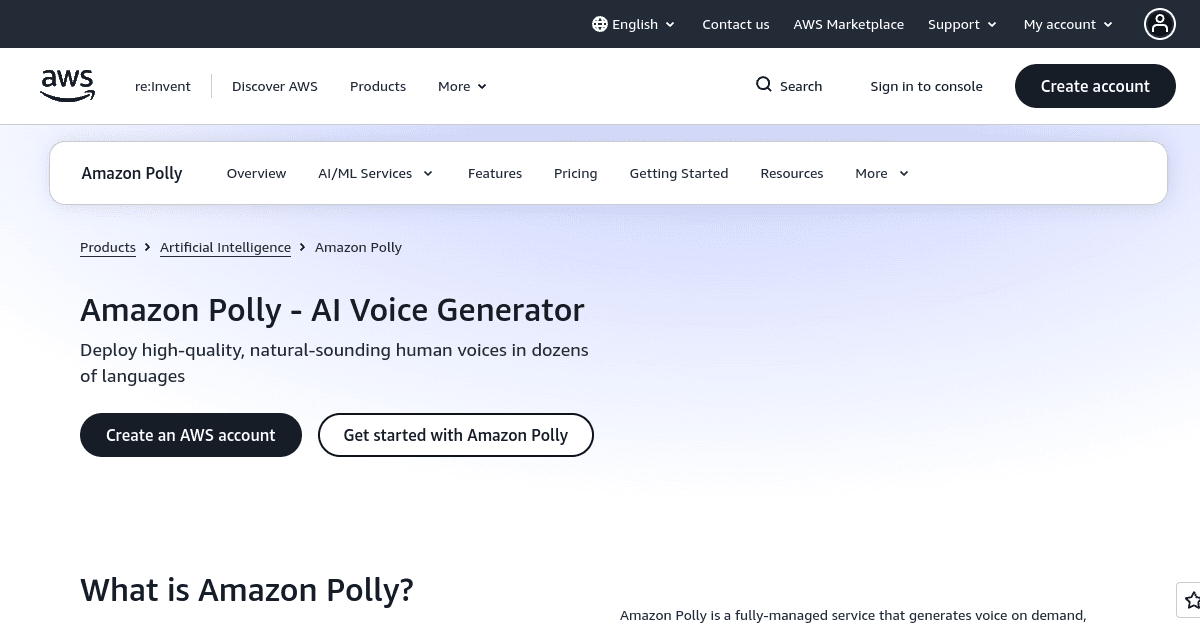
Amazon Polly is a cloud text-to-speech service within Amazon Web Services that turns written text into audio through a set of deep-learning voice engines, and it is aimed squarely at developers rather than at people who want a point-and-click editor. That framing matters more than any single feature, because Polly is delivered as an API and set of SDKs, not as a polished studio app. If your first question is "where is the timeline where I drag clips around," this is not that kind of product. If your question is "how do I generate speech programmatically inside an app I am already building," it fits naturally.
According to AWS, Polly provides more than 100 male and female voices across 40+ languages and language variants. The service exposes four distinct voice engines, each with its own price and quality profile: Standard, Neural (NTTS), Long-Form, and Generative. That tiering is one of the more useful aspects of the product, because it lets you match audio quality to the job instead of paying premium rates for everything. A batch of system notifications can run on the cheaper Standard engine, while a customer-facing narration can use Neural or Generative voices.
Control over pronunciation comes from two mechanisms AWS documents. The first is SSML, the W3C markup standard, which Polly supports for phrasing, emphasis, intonation, pitch, speech rate, volume, a whispered effect, and a newscaster speaking style (available on a limited set of voices such as US English Matthew and Joanna). The second is custom lexicons, XML files that let you override how acronyms, brand names, or internal jargon are spoken. Both are the kind of thing that separates a demo from production use: default output usually sounds fine until it mispronounces your company name in every clip, and lexicons are the fix.
For synchronization work, Polly can return Speech Marks, a metadata stream that provides timing information for sentences, words, and individual sounds. This is what you would use to highlight text as it is read aloud, animate a character's mouth, or drive captions. Output is available as MP3, Ogg Vorbis, or raw PCM at sampling rates up to 24 kHz. Access is through the API, AWS Management Console, CLI, and SDKs for Java, Node.js, .NET, PHP, Python, Ruby, Go, and C++, plus an HTTP API with bidirectional streaming. AWS also documents a Brand Voice option: a custom NTTS voice built in engagement with the Polly team, which is a managed engagement rather than a self-serve toggle.
Where it earns its keep
- Genuine breadth of voices and languages. 100+ voices across 40+ languages covers most localization needs from a single vendor, which avoids stitching together multiple TTS providers.
- Four engines with separate pricing. You can deliberately trade cost against quality per use case instead of being locked into one rate.
- Real production controls. SSML plus custom lexicons give you fine-grained pronunciation and delivery control, and Speech Marks make time-synced experiences (captions, lip-sync, karaoke-style highlighting) practical.
- Native AWS integration. Broad SDK coverage and documented integrations with Amazon Connect, Genesys Cloud CX, and the Amazon Chime SDK make it a low-friction choice for contact centers and apps already on AWS.
- Consumption pricing with no seat commitment. You pay per character synthesized, so a low-volume project costs little and there is nothing to cancel if usage stops.
Where it will frustrate you
- No editing studio. There is no drag-and-drop interface for arranging audio, adjusting individual words by ear, or exporting a finished narration project. Everything meaningful happens through code or the console.
- You inherit AWS complexity. Using Polly means dealing with IAM permissions, regions, and AWS billing. For a solo creator who just wants an MP3 of an article, that overhead is real and mostly unrelated to speech.
- Cost scales with characters, and the good engines cost more. At $100 per million characters, the Long-Form engine is 25x the Standard rate; heavy long-form production can add up faster than a flat-rate creator subscription.
- Best voices are limited to specific voice names. Long-Form and Generative engines are only available on a documented subset of voices, so your favorite language or accent may not offer the highest-quality engine.
- Brand Voice is not self-serve. Building a custom voice requires an engagement with the Polly team rather than uploading samples yourself, so it is not a quick option for small teams.
How the pricing breaks down
Polly uses a pay-per-character model with rates that differ by engine. AWS publishes the following per-million-character prices, alongside a monthly free tier that new accounts can draw on.
| Voice engine | Price per 1M characters | Free tier (monthly) |
|---|---|---|
| Standard | $4.00 | 5 million characters |
| Neural (NTTS) | $16.00 | 1 million characters (first 12 months) |
| Long-Form | $100.00 | 500,000 characters (first 12 months) |
| Generative | $30.00 | 100,000 characters (first 12 months) |
Beyond the per-engine free tier, AWS states that newly registered customers from July 15, 2025 receive up to $200 in AWS Free Tier credits usable across eligible services including Polly, available for six months after signup and expiring within 12 months of account creation. The practical takeaway is that evaluating Polly costs almost nothing, but budgeting for production means estimating character volume per engine. A useful rule of thumb: roughly speaking, a character count maps closely to your visible text length, so a 2,000-word article is on the order of 12,000 characters, and you can multiply against the relevant rate to sanity-check spend before committing. For more options in this space, the AI text-to-speech category lists comparable services.
Who should choose it, and who should not
Polly is a strong fit if you are a developer or a team already operating on AWS and you need speech generated inside software: an e-learning platform reading lessons aloud, an accessibility feature that voices on-screen content, an IVR or contact-center flow, a media pipeline that generates voiceovers at scale, or an app that needs multilingual audio without contracting several vendors. The documented integrations with Amazon Connect and Genesys Cloud CX reinforce that contact-center use case specifically.
It is a poor fit if you are a non-technical creator who wants to produce a finished podcast or YouTube voiceover through a browser interface, tweak emphasis by clicking on words, and download a polished file. That workflow exists in dedicated creator-focused TTS tools; Polly deliberately does not compete there. It is also worth pausing before committing if your team has no AWS presence at all, since the account, permissions, and billing setup are non-trivial for a single narration need.
The bottom line
Amazon Polly is a competent, deeply integrated text-to-speech API that rewards teams comfortable with AWS and penalizes those who are not. Its four-engine model gives real control over the cost-versus-quality tradeoff, its SSML and lexicon support and Speech Marks make production-grade and time-synced audio achievable, and consumption pricing keeps small projects cheap while letting large ones scale. The catch is that all of this arrives as developer infrastructure, so the value depends heavily on whether "call an API and manage AWS" describes how you want to work. For engineering teams the answer is often yes; for hands-on content creators, a studio-style tool will usually be the better home. You can compare it against other options in the full tool directory.
Common questions about Amazon Polly
How many voices and languages does Amazon Polly support?
AWS states that Polly offers more than 100 male and female voices across 40+ languages and language variants, so it covers most localization needs from a single provider.
What are the different Amazon Polly voice engines?
Polly provides four engines: Standard, Neural (NTTS), Long-Form, and Generative. They differ in quality and price, and the Long-Form and Generative engines are available only on a documented subset of voices.
Is Amazon Polly free to use?
There is a free tier: 5 million Standard characters per month, plus 1 million Neural, 500,000 Long-Form, and 100,000 Generative characters per month for the first 12 months. AWS also offers new customers up to $200 in Free Tier credits that can be applied to Polly. Beyond those allowances, usage is billed per character.
Can I control pronunciation in Amazon Polly?
Yes. Polly supports SSML for emphasis, intonation, pitch, rate, volume, and effects like whispering, and it supports custom lexicons for overriding how acronyms, brand names, or specialized terms are pronounced.
Can Amazon Polly synchronize audio with text?
Yes. Polly can return Speech Marks, a metadata stream with timing for sentences, words, and sounds, which lets you build features such as caption highlighting or lip-sync animation.