
What does Zapier actually do?
Zapier moves data and triggers actions between the software you already use, without you writing code. You build a workflow (Zapier calls it a Zap) by choosing a trigger in one app and one or more actions in others: a new row in a spreadsheet creates a task in your project tool, a form submission adds a contact to your CRM and pings a Slack channel, a paid invoice files a copy in cloud storage. The platform advertises connections to more than 9,000 apps, which is the single reason most people reach for it. If two tools you rely on both integrate with Zapier, you can usually wire them together in an afternoon instead of waiting on an engineering ticket or paying for a custom integration.
The model is deliberately literal. A trigger fires, Zapier runs the steps you defined, and each successful step consumes usage. Beyond the basic one-trigger-one-action pattern, Zapier supports multi-step Zaps that chain several actions, Filters that stop a workflow unless a condition is met, Paths for branching logic (if the deal is over a threshold, route it one way; otherwise another), and a Formatter for reshaping data between apps, such as splitting a name field or reformatting a date. These four capabilities are what separate a toy automation from something you can actually run a process on, because real workflows rarely follow a single straight line.
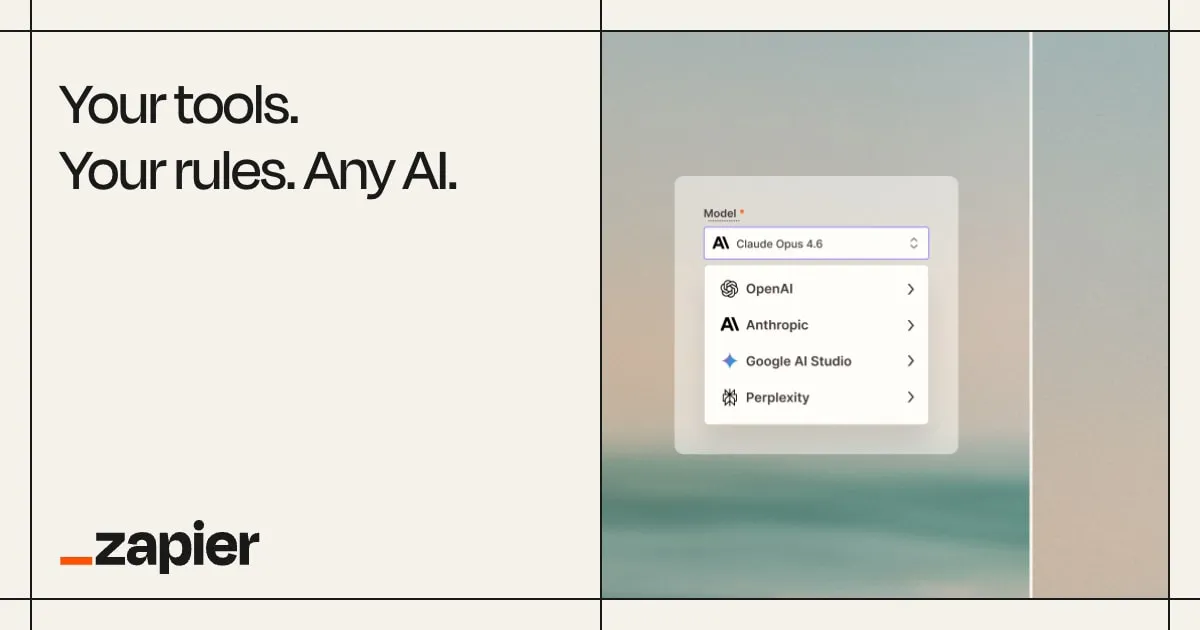
More recently Zapier has layered its own building blocks on top of integrations. Tables give you a database to store and reference data inside Zapier itself; Interfaces let you put a simple form or app front-end on top of your automations; and Chatbots provide AI-driven conversational flows. The company has also pushed into agentic automation with Agents, which can take actions across your connected tools, Canvas for mapping and documenting workflows, and support for the Model Context Protocol so assistants like Claude and ChatGPT can reach Zapier-connected apps. An AI Zap builder can draft an automation from a plain-language description. Treat these AI pieces as maturing rather than settled: they are genuinely useful for first drafts and lightweight tasks, but you should test and constrain anything that writes to production systems.
Who is it a good fit for?
Zapier is aimed squarely at people who understand their process but do not want to (or cannot) code. Operations managers, marketers, founders, freelancers, and small support or sales teams get the most out of it, because their pain is usually repetitive glue work: copying leads between systems, notifying people, keeping two tools in sync, or generating routine records. If your bottleneck is manual data entry across SaaS apps, this is the category of tool that removes it.
It is also a reasonable choice for larger organizations that need governance around who can build what. Zapier documents team Workspaces with inherited controls, role-based access, SCIM provisioning for identity providers, log streaming to monitoring platforms, managed app connections controlled by IT, and compliance attestations including SOC 2 Type II and GDPR. The company says it is trusted by more than 3 million businesses. That said, an engineering-heavy team that already runs its own event bus, queues, or a maintained internal integration layer will find Zapier less compelling; at high volume, code you control is cheaper and more predictable than per-task billing.
What does it cost, and where does the meter run?
Zapier uses a freemium model. There is a free plan that lets you try the product and run limited automations, which is enough to validate whether a workflow is worth building before you pay. Paid plans are tiered and scale with how much you automate and how many people are involved, unlocking higher usage, multi-step Zaps, premium app access, and team and administrative features as you move up.
The important thing to understand is that Zapier's cost is driven by usage, not just a flat seat price. Every action a Zap runs counts against your allowance, so a single busy workflow firing thousands of times a month can consume far more than several rarely-triggered ones. This has two practical consequences. First, put Filters early in a Zap so it stops before running paid steps on data you do not care about. Second, estimate volume before you commit: a workflow that looks cheap in testing can become your largest line item once it runs against real traffic. The vendor does not publish a single fixed price that fits every account, and the exact tier names, task allowances, and dollar figures shift over time, so confirm the current numbers on Zapier's own pricing page against your expected volume rather than trusting a third-party quote.
The strengths worth paying for
- Breadth of integrations. With 9,000+ supported apps, the odds that your specific tools are covered are high, which is the whole value proposition and hard for narrower automators to match.
- Genuinely no-code. Non-technical users can build, test, and monitor workflows without developer involvement, collapsing the time between "we should automate this" and having it running.
- Real branching logic. Multi-step Zaps, Paths, Filters, and Formatter let you model conditional, multi-outcome processes rather than only simple one-to-one syncs.
- Data and front-end tools built in. Tables, Interfaces, and Chatbots mean some workflows can live entirely inside Zapier instead of requiring yet another app.
- Enterprise governance. Role-based access, SCIM, managed connections, log streaming, and compliance certifications make it defensible for IT to sanction rather than ban.
The catches to weigh
- Usage-based cost can surprise you. High-frequency workflows consume allowance quickly, and pricing scales with volume; without upfront estimation the bill can outrun the value.
- You depend on someone else's integrations. If an app's Zapier integration lacks the specific trigger or action you need, you are stuck with what is exposed, and integrations can change underneath you.
- Debugging distributed workflows is fiddly. When a multi-step Zap fails partway, tracing which step and why takes patience, and silent failures in background automations are easy to miss.
- The AI features are still maturing. Agents, chatbots, and the AI builder are helpful for drafts and light tasks, but they need testing and guardrails before you trust them with anything consequential.
- Not the cheapest option at scale. For very high volumes or teams with engineering capacity, custom-built integrations are typically more cost-effective and controllable.
Final verdict
Zapier earns its position by removing a real, mundane cost: the human time spent shuffling data between tools that do not talk to each other. For non-technical teams and small businesses, the combination of enormous app coverage, honest no-code building, and enough logic (Paths, Filters, Formatter) to handle branching workflows makes it a dependable default, and the newer Tables, Interfaces, and agentic features extend how far you can go without leaving the platform. The reservation is economic rather than functional: because you pay by usage, Zapier rewards people who plan their workflows and filter aggressively, and it penalizes those who let noisy triggers run unchecked. Start on the free plan, prove one or two workflows deliver measurable time savings, model the volume, then scale up deliberately. If you want to compare it against other options in the same space, browse the AI workflow automation category or the wider tools directory before committing.
Common questions about Zapier
How many apps does Zapier connect to?
Zapier advertises integrations with more than 9,000 apps. That breadth is its core selling point, and it means most mainstream SaaS tools you use are likely to have a connection you can build a workflow around.
Do I need to know how to code to use Zapier?
No. Zapier is a no-code platform: you build automations by selecting triggers and actions in a visual editor, and there is an AI Zap builder that can draft a workflow from a plain-language description. Coding skills are not required to create or run Zaps.
Is there a free version of Zapier?
Yes. Zapier offers a free plan with limited usage, which is enough to test whether a specific automation is worth building. Paid plans are tiered and scale up with the volume you automate and the size of your team.
What are Zaps, Paths, and Filters?
A Zap is a single automated workflow with a trigger and one or more actions. Filters stop a Zap from continuing unless a condition is met, and Paths let a single Zap branch into different action sequences depending on the data, so one workflow can handle multiple scenarios.
Can Zapier work with AI assistants?
Yes. Zapier supports the Model Context Protocol, which lets assistants such as Claude and ChatGPT reach Zapier-connected apps, and it offers its own Agents and Chatbots for AI-driven automation. As with any AI-driven action, test and constrain these before using them on production systems.