

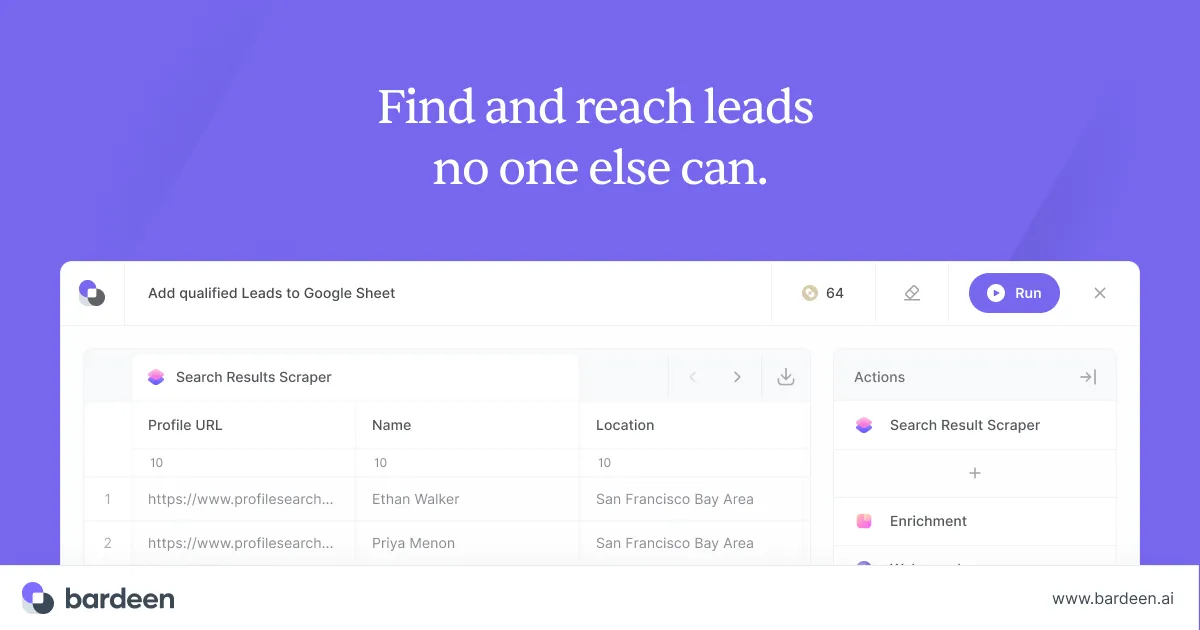

After spending time with the current version of Bardeen and its documentation, the clearest way to describe it is a browser-native workhorse for pulling structured data off the web and moving it into the tools where you actually work. It positions itself as no-code AI automation for browser-based workflows and scraping, and that framing holds up: the product runs inside your browser, leans heavily on extracting and enriching data, and asks you to think in terms of rows and actions rather than scripts or APIs.
The category matters here. Bardeen sits in AI workflow automation, but it is not a general-purpose integration platform in the mold of a traditional workflow builder that stitches back-end systems together. Its center of gravity is the page in front of you. You point it at a website, tell it what to collect, and it returns clean, tabular output. That distinction shapes almost everything about who should and should not consider it.
What Bardeen actually does
The core capability the vendor puts front and center is the web scraper, described on its site as the most powerful scraper available. Practically, that means you can build a custom scraper against a site's structure or use one of the pre-built scrapers Bardeen ships for common sources. The homepage names templates for sites such as LinkedIn-adjacent research targets, GitHub, YouTube, Crunchbase, Upwork, Product Hunt, Zillow, Realtor, Facebook, and Instagram, among others. The exact number of pre-built templates is not published as a single figure on the pages I reviewed, so treat any specific count with caution.
Around the scraper are three related functions that Bardeen groups together: web search, which is pitched as a way to research leads without manual Googling; enrichment, which appends validated phone numbers and email addresses to records; and AI-driven qualification, which scores or prioritizes prospects. There is also a "get answers with AI" action for asking a question about a page and getting a structured response back. These features are consistent with the tool's stated purpose, though the underlying models and accuracy rates are not documented publicly, so I would not make claims about enrichment match rates or deliverability without testing on your own lists.
The AI layer, in perspective
Bardeen's marketing describes AI-powered lead qualification and an AI answer action, and the older public description of the product referenced a natural-language workflow builder called Magic Box that turns a plain-English request into an automation. The Magic Box name did not appear in my review of the current site, so I would treat it as either renamed, folded into the AI actions, or deprecated rather than a guaranteed current feature. What is verifiable today is narrower and more honest to describe as AI actions layered onto a scraping pipeline: using a model to answer questions about scraped content and to sort leads by fit. That is genuinely useful for research work, but it is a step short of a system that designs complex multi-branch workflows for you. If your interest in Bardeen hinges on describing an arbitrary workflow in prose and having it built automatically, verify that specific capability in a trial before committing.
Usability and the shape of the work
Because Bardeen lives in the browser and organizes output as rows of data, the learning curve is gentler for someone comfortable with spreadsheets than for someone expecting a visual flowchart of triggers and branches. You are largely working in a data-out mindset: define a source, run it, review rows, and route them onward. The tool exports to CSV and connects to destinations including Google Sheets, Airtable, and Notion, which covers the common landing spots for scraped and enriched data.
That design is a strength and a constraint at once. The strength is immediacy: for repetitive research and data-collection chores, you can get to a useful result quickly without engineering help. The constraint is that anything requiring deep back-end orchestration, server-side scheduling independent of a browser session, or tight coupling to internal systems will push against the edges of what a browser-centric tool is built for. Teams that need durable, headless, always-on pipelines should scope that carefully.
How pricing works
Bardeen uses a credit-metered model, and understanding it is the most important part of judging cost. Every row an action produces consumes credits: a scraper row costs 1 credit, a web search row 1 credit, an AI tools row 1 credit, and an enrichment row 3 credits. Importing data, using utilities, and exporting to CSV are free. All plans include 100 free credits per month, and unused credits expire at the end of each billing period rather than rolling over.
The published paid tiers are as follows.
| Plan | Price | Monthly credits | Notable inclusions |
|---|---|---|---|
| Free | $0 | 100 | Base access to actions and exports |
| Basic | $10/month | 100 | Build your own scrapers, premium scrapers, enrichment |
| Premium | $50/month (or $480/year, ~20% off) | 1,000 | Everything in Basic plus team features |
| Enterprise | Custom, annual | Custom bulk | Scraper building and maintenance, premium support |
The economics reward you for knowing your volume in advance. Because enrichment is triple-priced and credits expire, the 100-credit Free and Basic allowances are realistically evaluation or light-use budgets rather than production capacity. If you enrich even a few hundred records a month, you are quickly into Premium territory, and heavy enrichment at scale is what the Enterprise custom bulk pricing exists to absorb. Anyone comparing Bardeen on price alone should model expected rows per month against these rates before assuming a low sticker cost translates to a low bill.
Who it fits and who should look elsewhere
The audience Bardeen names for itself is telling: sales development reps and account executives, revenue and sales operations teams, recruiters, solopreneurs, and vertical roles such as real estate agents and private equity researchers. These are all people whose day includes repetitive web research, list building, and moving contact data between tools. For that work, a browser-based scraper with built-in enrichment and lightweight AI qualification is a reasonable fit, and the credit model is legible enough to budget against.
I would be more cautious recommending it to engineering-led teams that want programmable, headless automation, or to organizations whose primary need is connecting internal SaaS systems through their APIs rather than harvesting data from public web pages. The tool's identity is scraping and research, and that is where it earns its keep. You can compare it against other options in the same space on the tools directory, and broader context on automation approaches lives on the blog.
Where it stands
Bardeen is a focused, credible tool for a specific job: turning web pages into structured, enriched, actionable data without code. Its strengths are a low barrier to entry, a scraping engine the vendor markets as best-in-class, and integrations with the spreadsheets and databases most teams already use. Its watch-outs are the expiring, action-metered credits that can make costs climb with volume, an AI layer that is more research-assist than autonomous workflow architect, and a browser-bound design that is not built for deep server-side orchestration. If your work is web research and list building, it is worth a trial on the free credits before you decide.
Common questions about Bardeen
Does Bardeen require coding?
No. Bardeen is a no-code platform that runs in the browser, letting you build scrapers and workflows without writing code.
How does Bardeen charge for usage?
It uses credits. Scraper, web search, and AI tool rows cost 1 credit each, while enrichment rows cost 3 credits. Importing, utilities, and CSV export are free. Every plan includes 100 free monthly credits, and unused credits expire at the end of the billing period.
What does Bardeen cost per month?
There is a free tier with 100 credits. The Basic plan is $10/month with 100 credits, Premium is $50/month (or $480/year) with 1,000 credits, and Enterprise is custom-priced and billed annually.
Which tools can Bardeen send data to?
The site names Google Sheets, Airtable, and Notion as destinations, and it supports CSV export.
Who is Bardeen best suited for?
It targets sales and revenue operations teams, SDRs and account executives, recruiters, solopreneurs, and vertical researchers such as real estate and private equity professionals who do repetitive web research and list building.