

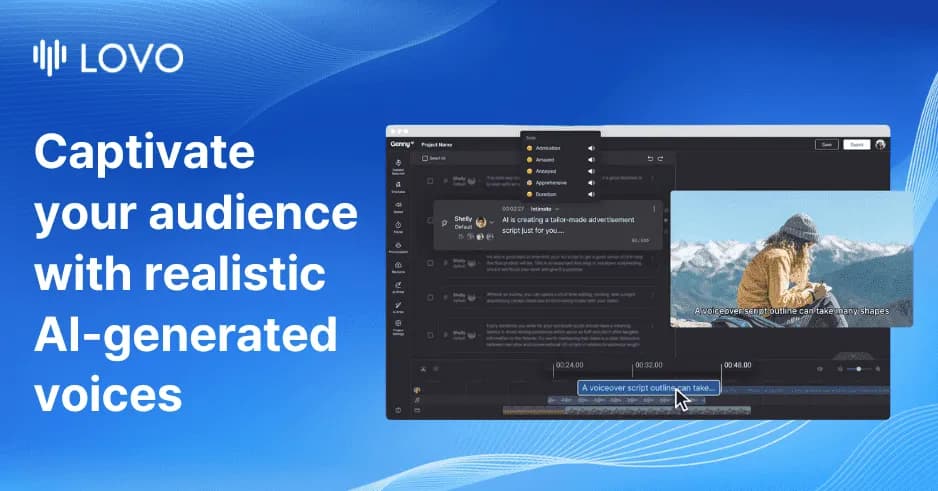

The short version: Lovo AI is a strong fit if you produce narrated video, e-learning, or social content and want your voiceover, script, subtitles, and a basic video edit to live in one workspace. It is a weaker fit if you only need a raw TTS API endpoint, or if you require published, itemized pricing before committing to a tool, because the vendor does not lay out its paid tiers openly.
Where this tool earns its keep
Lovo AI is marketed both under its own name and as Genny, the studio you actually work in. The product's identity is less "a TTS engine" and more "a narration-first content studio." That framing matters, because it changes who should care about it. The people who get the most out of Lovo tend to overlap on one trait: they are turning written material into finished spoken-audio or video, repeatedly, and they would rather not stitch three tools together to do it.
- E-learning and course creators who convert modules and scripts into consistent narration across many lessons.
- Video producers and YouTube creators who want to generate a voice track and lay it against footage without exporting to a separate editor first.
- Marketing and social teams producing short, high-volume clips in multiple languages where re-recording with human talent is impractical.
- Podcast and audiobook editors needing long-form narration or gap-filling in a consistent voice.
- Teams that want a branded voice reproduced across assets through cloning rather than re-hiring the same voice actor.
If your work is none of those — say you just want to occasionally read an article aloud — the studio is more machinery than you need. You can find lighter-weight options in the AI voice generator category.
What the platform actually does, and the tradeoffs
A large voice and language library
Lovo advertises more than 500 AI voices spanning over 100 languages, with regional variety across a wide list of countries. For multilingual output, breadth like this is the whole point: it lets one team localize the same script into many markets without sourcing native speakers for each. The realistic caveat is that a big catalogue is not a uniform catalogue. Coverage and naturalness typically vary by language, and the polish you hear in a flagship English voice is not guaranteed in a less-common locale. Budget time to audition specific voices in your target languages rather than assuming parity across all 100+.
Voice cloning from a short sample
The platform can build a custom voice from about one minute of audio. For a brand or a solo creator, that is the feature that turns "generic AI narration" into "our narration" — a recognizable, reusable voice across a library of content. The tradeoff is responsibility, not technology: cloning a voice you do not own the rights to is a legal and ethical problem regardless of how easy the tool makes it. Treat consent and licensing of the source recording as a prerequisite, not an afterthought.
Directable, expressive delivery
Lovo's newer Pro voices are pitched as "directable" — you steer emotion and emphasis using natural language rather than fighting with raw markup. This is where TTS tends to succeed or fail for real projects. Flat, robotic delivery is fine for a system prompt and unacceptable for a story or an ad. Expressive control is what makes the difference between audio you ship and audio you re-record with a human. Expect to iterate: getting the intended tone usually takes a few passes, and results are best judged with your own script, not the demo reel.
Genny: the built-in video editor
The reason many users choose Lovo over a pure TTS service is Genny, the online editor that syncs generated voiceovers with visuals in the same place you wrote and voiced them. Keeping narration and timeline together removes the export-import round trip that eats time in a typical pipeline. It is a genuine convenience for creators. It is not, however, a replacement for a professional non-linear editor — if your video work is complex, treat Genny as a fast first pass or a finisher for simple pieces, and keep your heavyweight editor for the rest.
Script writer and auto subtitles
An AI script writer helps get past a blank page before you convert text to speech, and an automatic subtitle generator produces captions in 20+ languages with styling and animation options. Subtitles in particular are less of a nicety than they look: captions drive watch time and accessibility on social platforms, so generating them inside the same tool that made the audio is a practical saving. As with any generated script or auto-transcript, the output is a draft that needs a human read before it ships.
API access
For developers, Lovo exposes an API the vendor describes as callable in as few as roughly five lines of code. That is the path for teams that want voice generation inside their own product or an automated content pipeline rather than in the studio UI. The studio and the API serve different buyers; be clear which one you are actually adopting, because they imply different workflows and, likely, different plans.
Limitations and things to check before you commit
- Pricing is not published in detail. The site promotes a free plan and a 14-day Pro trial but does not lay out tier names, prices, or per-plan character and cloning limits openly. That opacity makes it hard to compare cost of ownership up front, and it means quotas can bind before you expect them to. Confirm current limits and price directly with the vendor before scaling usage.
- Commercial-rights terms need direct confirmation. The vendor lists content ownership as a support topic but does not spell out the answer on its main pages. If you are producing client work or monetized content, verify commercial usage and ownership in writing against your chosen plan rather than assuming it is included.
- Quality varies by language and voice. A 500-voice, 100-language catalogue is a range, not a guarantee. Audition the exact voices you plan to use.
- Web-only workflow. Lovo Studio runs in the browser. That is fine for most users but implies a dependable connection and no offline production.
- Cloning is a legal surface, not just a feature. Ease of cloning does not confer the right to clone. That is on the user.
What it costs
Lovo uses a freemium model. There is a free plan with limited monthly usage, and the vendor offers a 14-day trial of the Pro experience with no credit card required, which is a low-friction way to test the studio against a real project. Beyond that, specific paid tier names, monthly and annual prices, and per-plan quotas for characters, voice clones, commercial rights, and API access are not publicly documented on the site at the time of writing — you will need to view the live pricing page or contact the vendor to confirm them. I have deliberately not published a tier table here, because inventing numbers would defeat the purpose of a review. The practical approach is to run the free plan and the Pro trial on your own scripts, measure how quickly you hit limits, then price accordingly.
How it stacks up against the alternatives
The AI voice space is crowded, and the honest guidance is about fit rather than a winner. Lovo's differentiator is the bundle: TTS plus cloning plus an in-app video editor and subtitles. If that all-in-one workflow is what you want, few pure TTS engines match it without extra tools bolted on. If, instead, you only need the highest-fidelity voice model and will handle editing elsewhere, a specialist TTS provider or an API-first service may serve you better and possibly cheaper. Buyers who prioritize transparent, published pricing may also prefer a competitor that lists tiers openly. Rather than name-drop rivals I cannot verify here, I'd suggest shortlisting two or three tools from the voice generator listings and running the same script through each; ear-test results and per-project cost beat spec sheets every time. Our blog and the wider tool directory can help you build that shortlist.
Questions buyers actually ask
Is Lovo AI the same thing as Genny?
Effectively yes. Genny is the studio you work in; Lovo AI is the platform and brand. When people say they use Lovo, they usually mean the Genny editor where voice generation, cloning, scripting, subtitles, and basic video editing come together.
How much audio does voice cloning need?
The vendor states a custom voice can be created from about one minute of audio. You are responsible for having the right to use whatever recording you supply.
Can I try it before paying?
Yes. There is a free plan with limited monthly usage, plus a 14-day trial of the Pro experience that the vendor says requires no credit card. That is enough to test real scripts before deciding.
Does it support languages other than English?
Yes — more than 100 languages with regional variety across many countries. Quality can differ between languages, so audition the specific voices you intend to use.
Can I integrate Lovo into my own application?
Yes. Lovo offers an API the vendor describes as callable in as few as roughly five lines of code, aimed at embedding voice generation into other products or automated pipelines.