

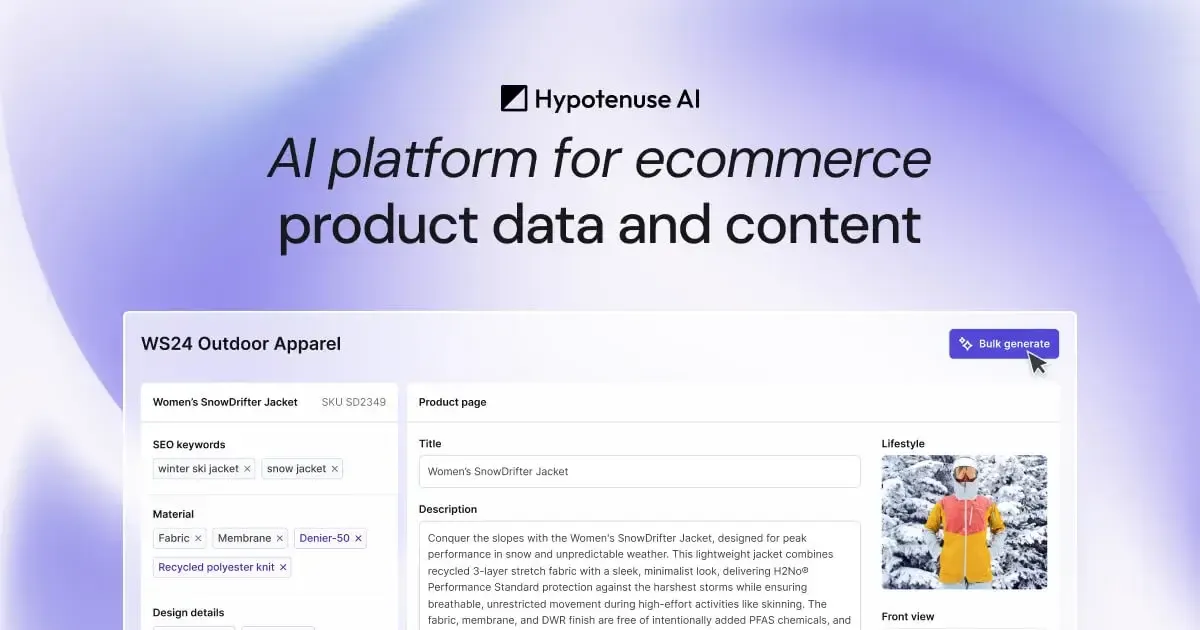

Most AI writing tools try to be everything to everyone. Hypotenuse AI has gone the other direction, narrowing its aim to a single, unglamorous but expensive problem: keeping thousands of ecommerce product listings accurate, on-brand, and discoverable. Approaching it as a reviewer who has watched a lot of generic copy generators come and go, the specialization is the first thing worth noting, because it changes who should and should not consider the product.
What the platform actually is
The vendor positions Hypotenuse AI as an AI-first product experience management (PXM) platform rather than a chat box that spits out paragraphs. In practice that means the software is built around a product catalog. It generates SEO-oriented product titles and descriptions in a defined brand voice, but it also does the less visible work around those listings: filling in missing product attributes, tagging and categorizing items against taxonomies, and cleaning up product photography. If you think of a copywriting tool as producing words, this is closer to a system that maintains an entire catalog's worth of structured content.
That framing matters because it sets realistic expectations. A team looking for a flexible assistant to draft emails, ad variations, and long-form thought-leadership will find the ecommerce orientation limiting. A team responsible for a store with hundreds or thousands of SKUs, where each product needs a title, a description, attributes, tags, and a usable image, is closer to the intended user.
The core content and catalog features
The headline capability is bulk product description generation. Rather than writing one listing at a time, the platform is designed to produce descriptions across many products at once, and the vendor advertises support for more than 20 content types beyond the basic description, including meta titles, meta descriptions, category page copy, and blog articles. For a store that has to populate both the product page and the surrounding SEO scaffolding, having those content types generated from the same product data reduces the manual copy-paste work that usually eats a merchandiser's day.
Two supporting features distinguish this from a plain text generator. The first is data enrichment: the platform is documented as filling in missing product attributes by drawing on web search, UPC databases, and spec sheets. This is genuinely useful because incomplete attribute data is one of the most common reasons a product ranks poorly or gets filtered out of a marketplace search, and cleaning it manually is tedious. The second is image handling. Hypotenuse AI offers photo editing and enhancement, background adjustment, precise cropping, resolution and noise improvements, and generation of lifestyle scenes. Bundling imagery with copy is a deliberate choice, since a product listing is judged on both, and doing them in separate tools creates version-control headaches.
Rounding out the feature set are automatic product tagging and categorization aligned to Google, Amazon, or custom taxonomies, translation and localization with support the vendor states as 40+ languages, and SEO and generative-engine (GEO) optimization that monitors rankings across search engines and marketplaces and suggests keywords. The taxonomy alignment in particular is the kind of feature that only makes sense once you have worked with marketplace feeds, where a mismatch between your category and the marketplace's expected category quietly suppresses visibility.
How much of this is real AI depth
It is fair to be skeptical of any product that stacks the word "AI" in front of every feature. Reading past the labels, the more defensible AI claims here are the ones tied to structured data: attribute enrichment from external sources, taxonomy-aware tagging, and brand-voice enforcement that applies custom guidelines and formatting consistently across an entire catalog. Consistency at catalog scale is a real, hard problem, and it is where a model that has ingested your brand rules earns its keep more than in any single clever sentence.
Brand voice is the feature I would scrutinize most during a trial. The value is not that the tool writes fluently, which most modern models do, but that it writes the same way across 5,000 items without a human re-checking tone on each one. The enterprise tier adds a guideline checker and bespoke AI models, which suggests the vendor treats brand compliance as a serious workflow rather than a toggle. Whether that holds up depends entirely on how strict and idiosyncratic your brand rules are, and that is something only a pilot against your own guidelines will tell you.
Fit, integrations, and day-to-day usability
Where Hypotenuse AI signals its intended audience most clearly is its integration list. It connects to commerce and PIM systems including Shopify, WooCommerce, BigCommerce, Salesforce Commerce Cloud, NetSuite, Salsify, Akeneo, Plytix, Stibo, and PIMcore, along with content platforms such as WordPress, Webflow, and Wix, and marketplaces including Amazon, Walmart, and Target. That is not a list assembled for hobbyists. Names like Salsify, Akeneo, and Stibo are enterprise product-information systems, and their presence tells you the product expects to sit inside an established commerce stack rather than replace it. The vendor also cites work with large brands such as MediaMarkt, Billabong, and Sam Edelman, reinforcing the enterprise posture, though buyers should treat client logos as directional rather than a guarantee of their own results.
On usability, the honest position is that the platform is built for teams and workflows, not solo speed. Enterprise features include team access controls, custom integrations, a dedicated account manager, and onboarding, all of which imply a product that rewards setup investment and punishes casual, occasional use. A single marketer looking to knock out a few descriptions this afternoon will find the ceremony disproportionate to the task. A merchandising team that will run the same enrichment and generation pipeline every week is the group that gets the payoff.
What it costs
Pricing is the least transparent part of the offering, and prospective buyers should go in expecting that. The vendor publishes tier names but not numbers. There is a free trial that requires no credit card, which is the right way to evaluate a tool like this before committing.
| Tier | Intended for | Notes |
|---|---|---|
| Basic | Sites with fewer than 100 products | 1 seat, 40+ languages, product description generator and 20+ content types; price quoted on request |
| Ecommerce Pro | Growing catalogs | All Basic features plus advanced capabilities; specific limits not published |
| Ecommerce Enterprise | Large teams with scale and compliance needs | Adds attribute enrichment, tagging and taxonomy management, PIM, bulk AI image editor, bespoke models, guideline checker, custom integrations, and a dedicated account manager; demo required |
The plans are structured around word allowances that refresh monthly on the subscription anniversary. One detail worth planning around: on monthly plans unused words do not roll over, while on annual plans they do. For a catalog that generates content in seasonal bursts rather than evenly, that difference can meaningfully affect which billing cadence makes sense. Because every tier is custom-quoted, treat the trial period as your real evaluation of cost-to-value, and press the vendor for concrete word and seat limits before signing.
Who should look elsewhere
This is not a general-purpose copywriter. If your primary need is ad copy, social posts, sales emails, or long-form editorial content unconnected to a product catalog, the ecommerce architecture here is overhead you will not use. Very small stores may also find the enterprise-leaning feature set and custom pricing heavier than their catalog justifies, though the Basic tier's sub-100-product framing suggests the vendor does want smaller merchants too. You can compare options in the same space through our AI copywriting category or browse the wider tools directory to weigh a focused catalog platform against broader writing assistants.
Where it lands
Hypotenuse AI is a credible, narrowly-focused tool for the specific job of running ecommerce catalog content at volume. Its strength is the combination of copy, structured attribute data, and imagery in one place, tied into serious commerce and PIM integrations. Its main frictions are opaque pricing and a team-and-workflow orientation that makes it a poor match for casual or general writing needs. Buyers who fit the profile should use the no-card trial to test brand-voice consistency and enrichment accuracy against their own catalog before negotiating a quote. For more on evaluating AI content tools, our blog covers the broader landscape.