

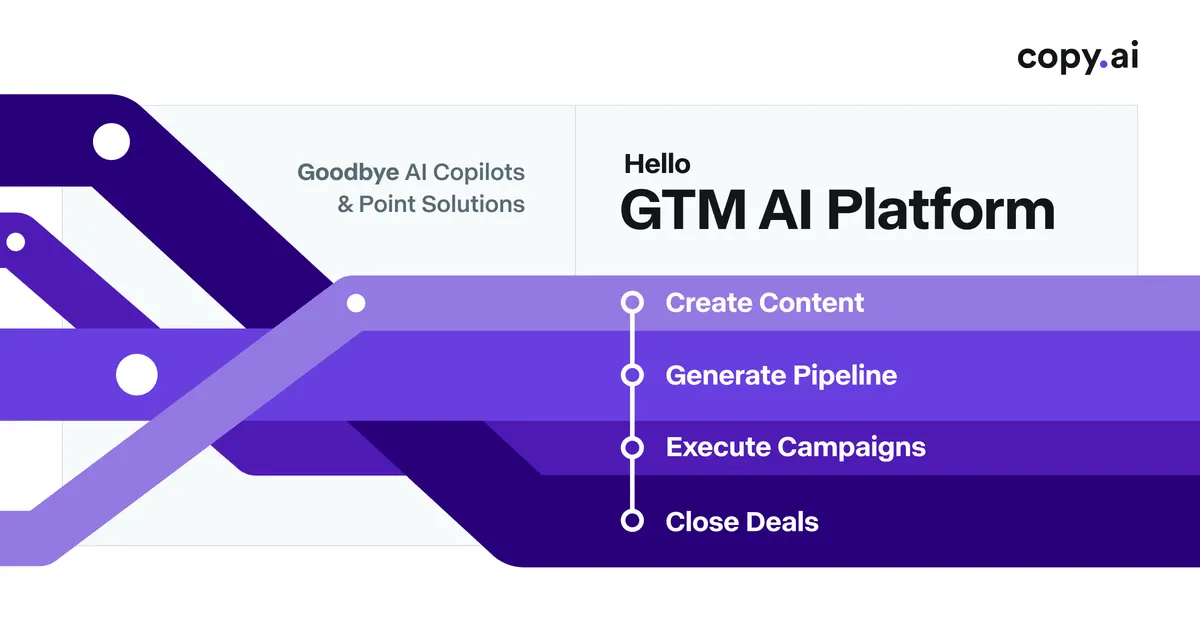

The first question worth asking about Copy.ai is not whether it writes good marketing copy, but what kind of team it is actually built for now. The product markets itself as "The First AI-Native GTM Platform," and that framing matters: it has moved well beyond the ad-headline and product-description generator many people remember. Compared with a straightforward AI writer that you open, prompt, and copy text out of, Copy.ai is trying to sit inside a revenue team's operations, connecting to a CRM, running multi-step processes, and enriching records. That difference in ambition is the single most important thing to understand before judging whether it fits your work.
What actually distinguishes it
Most tools in the AI copywriting category are optimized for a single loop: type an instruction, get text, refine, export. Copy.ai still supports that loop through its Chat interface for one-off tasks, but its distinguishing pieces are aimed at repeatable, team-scale operations rather than individual drafting. According to the vendor's own site, the platform is organized around a few named building blocks:
- Workflows codify a process or best practice into a repeatable, automatable pipeline. This is the core idea that separates Copy.ai from a text box: instead of re-prompting the same task, you build it once and run it at volume.
- Actions and Agents break functionality into reusable building blocks, with "Copy Agents" described as automated tasks that make decisions within guardrails. The practical value is offloading routine, rules-based steps rather than every step needing a human prompt.
- Tables provide a queryable data layer that consolidates multiple sources, so a workflow can operate on structured records rather than loose text.
- Infobase is a central store for company facts, positioning, and personas, and Brand Voice defines tone so outputs stay consistent across a team.
Two more verified points shape how flexible this is in practice. Copy.ai is model-agnostic, drawing on OpenAI, Anthropic, Google Gemini, and Perplexity rather than locking you to one engine, which is useful when different tasks favor different models. And it advertises over 2,000 integrations, naming Salesforce, HubSpot, Gong, Zapier, Outreach, and Salesloft among them. Those names tell you the target user clearly: this is aimed at sales, marketing, operations, and SDR teams who live inside a CRM, not at a solo blogger.
The realistic use cases
The site lists concrete scenarios that are worth taking at face value because they explain the pricing later: prospecting, inbound lead processing, deal coaching and forecasting, account-based marketing, content creation, translation and localization, lead and account intelligence, CRM enrichment, and GTM systems integration. The pattern is telling. The heaviest, most defensible value is in operational automation, feeding leads through a repeatable enrichment-and-outreach pipeline, keeping CRM data clean, generating first-draft outbound at scale. Pure content creation is present but is only one line item among many. If content is the only thing you need, you are buying a platform to use a fraction of it.
What the tiers cost, and whether the jump is justified
Copy.ai's published pricing has an unusually wide spread, and understanding the gap between the bottom tier and the rest is the crux of any buying decision.
| Plan | Price | Seats | Workflow credits |
|---|---|---|---|
| Chat | $29/mo ($24/mo billed annually) | 5 | None (unlimited words in chat) |
| Growth | $1,000/mo ($12,000/yr) | 75 | 20K/month |
| Expansion | $2,000/mo ($24,000/yr) | 150 | 45K/month |
| Scale | $3,000/mo ($36,000/yr) | 200 | 75K/month |
| Enterprise | Custom | Custom | Unlimited customizable workflows |
The Chat plan at $29/month gives five seats and unlimited words in chat with access to the major models, which is a reasonable price for team-based ad-hoc writing. But it does not include workflow credits, meaning the automation layer that defines the platform effectively begins at the Growth tier, which lists at $1,000/month. That is a large step. For a team evaluating Copy.ai, the honest read is that the low entry price and the platform's headline capability are not the same purchase. You are either buying a modestly priced collaborative chat writer, or you are committing to a four-figure monthly platform to unlock workflows, agents, and deep integrations. There is little middle ground in the published tiers.
The value calculus for the higher tiers depends entirely on whether you will actually build and run workflows at volume. Twenty thousand workflow credits and 75 seats at $1,000/month is defensible if you are automating lead processing or enrichment that would otherwise cost operations time or additional tooling. It is poor value if you signed up mainly to draft emails. Separately, Copy.ai publishes 70+ standalone free AI writing generators (cold email, outline, marketing email, and similar) that anyone can use without a plan, which is a sensible way to trial output quality before paying. Note that the main pricing page does not list a free tier for the full platform itself.
Where it falls short
- The pricing cliff. The gap from $29 to $1,000 per month is steep, and the automation features most people are drawn to sit on the far side of it. Smaller teams can find themselves paying platform prices to use platform features they only partly need.
- Complexity for simple needs. Workflows, Actions, Agents, Tables, and Infobase are powerful, but they carry a setup and learning cost. A freelancer or small marketing team that just wants clean drafts may never touch most of the product.
- Credit-metered automation. Workflow credits are capped per tier, so heavy automation users need to model consumption carefully; unlimited workflows only appear on custom Enterprise terms.
- Documentation gaps. The vendor does not publish exact credit-to-task conversions or free-tool usage limits on the pages reviewed, so real throughput is hard to estimate before committing.
How to think about alternatives
Because Copy.ai now spans two very different jobs, the right comparison depends on which job you have. If you only need on-brand marketing and sales copy, a single-purpose AI writer will usually be cheaper and simpler, and Copy.ai's own free writing generators can stand in for occasional drafting. If your real need is CRM-connected automation, prospecting pipelines, and data enrichment, then the fair comparison is against sales-ops and GTM automation platforms rather than against writing tools. Evaluate on integration depth with your existing stack (Salesforce, HubSpot, and the like) and on how much of your process you can genuinely codify into workflows. Browse the copywriting tools directory or the broader tool listings to line up options against your actual workflow before you commit to a tier.
Final assessment
Copy.ai is a credible, mature product that has made a deliberate bet on go-to-market automation over pure copywriting. For revenue teams that will build workflows, connect their CRM, and run tasks at scale, the higher tiers can be justified by the operational work they replace. For individuals and small teams whose need begins and ends with well-written copy, the platform is more than the job requires, and the pricing structure makes that mismatch expensive. Judge it by which of its two identities matches your team: the affordable collaborative writer, or the four-figure GTM engine. Both are real, but they are not the same product, and buying the second when you need the first is the most common way to overpay.