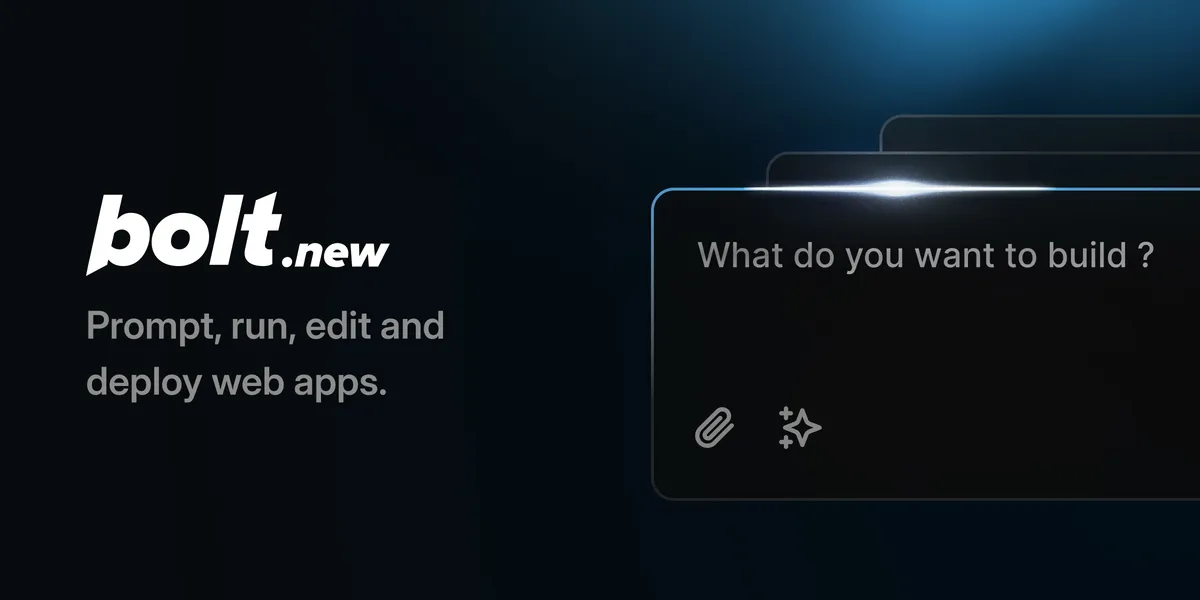

TL;DR: Bolt.new is a browser-based AI builder from StackBlitz that generates, runs, and deploys full-stack web apps from natural-language prompts, backed by a real Node.js runtime and its own hosting layer, Bolt Cloud. It moves fast for prototypes and small production sites, but its token-metered pricing means costs scale with iteration, so it rewards people who can prompt precisely and punishes trial-and-error workflows.
What Bolt.new Actually Is
Bolt.new pairs a large language model with a full development environment that runs entirely inside the browser. There is no local install, no terminal to configure, and no dependency setup on your machine. You describe what you want in plain English, and Bolt scaffolds the project, writes the code, installs packages, runs the app, and shows you a live preview. StackBlitz, the company behind it, has spent years building the in-browser runtime technology that makes this possible, which is the technical reason Bolt can spin up a working app without a server round-trip for every file change.
That distinction matters. Many AI coding tools generate code you then have to copy into your own editor and wire up yourself. Bolt closes that loop: the generated project is already running in front of you, and you can edit it, re-prompt it, or deploy it without leaving the tab. For someone validating an idea, that shortens the distance between "what if" and "here's a link you can click" to minutes.
The Capabilities Worth Understanding
Rather than list every checkbox, it helps to group what Bolt does around the jobs people actually hire it for.
Prompt-to-app generation with a running preview
The core loop is conversational: you type a request, Bolt produces the code and runs it. Because the app is live, you catch layout and behavior problems immediately instead of discovering them after a deploy. The practical benefit is tight feedback. The tradeoff is that each round of "actually, change this" consumes tokens, so the loose, exploratory prompting style that feels natural early on is also the most expensive way to work.
Automatic model routing and built-in error handling
Bolt routes tasks to different models depending on the job and includes automated testing and refactoring that the vendor markets as producing "98% less errors." Treat that figure as a marketing claim rather than an independently verified benchmark. The underlying idea is sound, though: automated checks catch a class of obvious mistakes before they reach you, which reduces the number of correction prompts, and therefore the number of tokens, you spend cleaning up.
Design system and import support
You can bring in existing work rather than starting cold. Bolt imports from Figma and from GitHub repositories, and it ships with design-system integrations including Material Design, Chakra UI, and Shadcn UI, alongside branded systems such as the Porsche and Washington Post design systems. For teams with an established visual language, this is the difference between a generic-looking prototype and something that resembles your product. The GitHub import in particular is what makes Bolt usable on an existing codebase, not just greenfield experiments.
Bolt Cloud: hosting, databases, and auth
Bolt is not only a code generator; it includes a backend layer. Bolt Cloud provides hosting with analytics and custom domains, unlimited databases, user management and authentication, and SEO tooling. This is the feature that turns a demo into a shippable product without stitching together three other services. If your app is modest in scope, you may never need to leave the platform to go live.
Where It Fits in Real Work
The clearest fit is rapid prototyping. A founder or product manager can turn a spec into a clickable app in an afternoon and put it in front of users or investors. Because everything runs in the browser, a non-engineer can get surprisingly far before needing to bring in a developer.
A second fit is small production sites and internal tools. With hosting, a database, authentication, and custom domains available on the platform, a marketing landing page, a signup form with a backend, or a lightweight internal dashboard can live entirely on Bolt. The Pro tier removes Bolt branding, which is the practical gate between "prototype" and "public-facing."
A third, quieter use is learning. Being able to prompt a change and immediately see the code and the running result makes Bolt a reasonable environment for someone teaching themselves modern web development, though the token meter means it is a less forgiving sandbox than a free local setup.
The situation Bolt fits worst is a large, mature codebase with strict architectural conventions and heavy custom tooling. The context and import features help, but an AI that rewrites files on your behalf inside a hosted environment is a different working model than an engineering team's existing pipeline, and the token economics get expensive at that scale.
How Pricing Works
Bolt uses a freemium model metered in tokens, which is the single most important thing to understand before you rely on it. Tokens are consumed by AI work, so heavy iteration burns through an allowance faster than careful, well-scoped prompts. The published tiers are:
| Plan | Price | Token allowance | Notable inclusions |
|---|---|---|---|
| Free | $0 | 300,000/day, up to 1M/month | Public and private projects, hosting, unlimited databases, Bolt branding on sites, 10MB uploads |
| Pro | $25/month | From 10M/month, no daily cap, rolls over | No Bolt branding, custom domains, SEO, 100MB uploads, AI image editing |
| Teams | $30/month per member | Pro-level | Centralized billing, access management, admin controls, private NPM registries |
| Enterprise | Custom quote | Not published | SSO, audit logs, compliance, dedicated account manager, 24/7 support |
The vendor states that annual billing saves up to 28% versus monthly. A useful detail is that Pro tokens roll over month to month and there is no daily cap, which suits people who work in bursts rather than every day. The free tier's daily and monthly limits are enough to build and evaluate something real, but the persistent Bolt branding on hosted sites signals that it is meant as a trial rather than a permanent home for a public product. You can compare it against other options in the AI website builder category before deciding.
What Works
- No local setup at all; a working full-stack app runs in the browser within minutes of your first prompt.
- The generate-run-edit-deploy loop lives in one place, which removes the copy-paste friction common to other AI code tools.
- Bolt Cloud folds hosting, databases, authentication, custom domains, and SEO into the same product, so small apps can ship without external services.
- Figma and GitHub imports plus real design-system support mean you are not limited to generic-looking, from-scratch prototypes.
- Pro's rolling tokens and absence of a daily cap fit intermittent, project-based work.
The Limits and Tradeoffs
- Token metering ties cost directly to iteration. Vague or trial-and-error prompting is the most expensive way to use it, and unpredictable spend is a genuine concern for sustained, large builds.
- The "98% less errors" and "1,000 times larger" context claims are vendor marketing, not independently verified benchmarks; do not plan around them as guaranteed outcomes.
- The free plan places Bolt branding on hosted sites, so anything public-facing effectively requires a paid tier.
- Working inside a hosted, AI-driven environment is a poor match for large, convention-heavy codebases and established engineering pipelines.
- Mobile or native app support is not documented on the site, so treat Bolt as a web-app tool unless the vendor states otherwise.
Verdict
Bolt.new is a strong choice when speed from idea to running web app matters more than fine-grained control, and when your project is small enough to live comfortably on Bolt Cloud. Prototypers, solo founders, and small teams shipping landing pages, signup flows, or internal tools will get the most from it, especially on the Pro tier where branding disappears and tokens roll over. The people who should be cautious are those running large, established codebases or anyone whose workflow depends on heavy iteration, because the token meter turns exploration into a recurring cost. If you can prompt with intent and your scope is contained, it earns its place; if you tend to build by endless tweaking, budget for it accordingly. Browse more options in the tools directory or read comparisons on the blog before committing.
Common Questions
Who builds Bolt.new?
Bolt.new is made by StackBlitz, the company behind the in-browser runtime technology that lets the environment run a full Node.js project without any local installation.
Is there a genuinely free plan?
Yes. The free plan costs $0 and includes 300,000 tokens per day, up to 1 million per month, along with hosting, unlimited databases, and public or private projects. Sites built on the free plan carry Bolt branding.
What does the Pro plan cost and what does it add?
Pro is $25 per month billed monthly, with annual billing advertised as saving up to 28%. It starts at 10 million tokens per month with no daily cap and tokens that roll over, removes Bolt branding, and adds custom domains, SEO tooling, 100MB uploads, and AI image editing.
Can I bring in existing designs or code?
Yes. Bolt imports from Figma and from GitHub repositories, and it supports design systems including Material Design, Chakra UI, and Shadcn UI, so you can start from existing work rather than a blank project.
Can it deploy and host the app for me?
Yes. Bolt Cloud provides hosting with analytics and custom domains, along with databases, user management, and authentication, so a small app can go live without setting up separate external services.