


The right question with a tool like Teal is not "is it good?" but "good compared to what, for which part of the job hunt?" Job seekers usually stitch together several products: a resume editor, a spreadsheet to track applications, a keyword checker, and a browser bookmark folder full of listings. Teal's pitch is that one workspace can absorb all of those. Judged against that specific promise, it does most of the job well, with a clear boundary around what it deliberately does not do.
Teal (from the company tealhq) positions itself as an AI career platform for people running an active, often high-volume search. If you send two or three applications a month, most of what follows is overkill. If you are tailoring a resume to dozens of roles and losing track of who you emailed and when, the way the pieces connect is where the value shows up.
What actually distinguishes it
The differentiator is not any single feature. Standalone resume builders, ATS checkers, and application trackers all exist elsewhere. Teal's edge is that the tracker, the resume, and the match analysis reference the same data. When you save a job, you can attach it to a specific resume version, then run a comparison that scores how closely that resume aligns with the posting and surfaces missing keywords.
- Match scoring tied to real postings. Teal's Matching Mode lets you link a resume to a saved job, run an "Analyze & Compare," and get a match score plus keyword gaps. This matters because generic "ATS score" tools grade a resume in a vacuum; scoring against the actual description is the only version of that check that reflects how you will be measured for a given role.
- Version control for resumes. Because you keep multiple resume versions in one place and map each to a job, you avoid the classic failure mode of emailing the wrong tailored file. For someone applying broadly, this organizational discipline is arguably more valuable than the AI text generation.
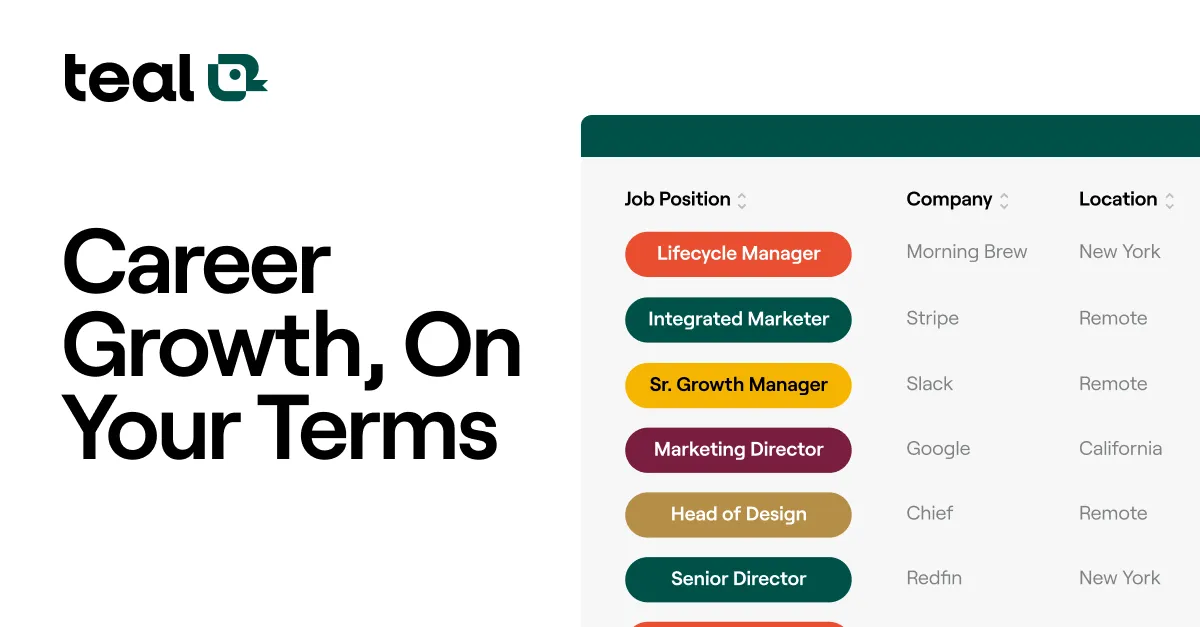
- A tracker built for the search, not repurposed. The job tracker handles bookmarking roles, setting status, adding notes, and tracking companies and contacts. Unlimited tracking is available even on the free tier, which removes the usual reason people fall back to a spreadsheet.
- A browser extension that feeds the workspace. The Chrome extension captures listings from many job boards (Teal cites 40+, including LinkedIn, Indeed, and Glassdoor) straight into your tracker, so the collection step happens where you already browse rather than in a separate tab.
The feature set in practice
Beyond the connective tissue, the core building blocks are competent on their own terms:
- Resume builder and templates. You can build from scratch or import from a LinkedIn profile, then export. Teal keeps resume editing and export unlimited on the free tier, which is unusual and worth noting up front.
- Resume checker / score. A structured review gives feedback on formatting, structure, and content quality, useful mainly as a first-pass sanity check before you tailor for a specific role.
- AI writing help. Teal can generate and rewrite bullet points, summaries, and related content. On the free plan this is metered by a limited pool of AI credits; the practical purpose of the paid tier is to remove that ceiling.
- A wider free tool library. Teal publishes a large set of free career tools (it advertises 50+) around the core builder and tracker, which lowers the barrier to trying it before committing to anything paid.
A realistic expectation: the AI is an assistant for phrasing and keyword alignment, not a ghostwriter that produces a finished, truthful resume unprompted. You still supply the substance and verify every claim. Treated that way, it saves editing time; treated as autopilot, it produces generic output like any other tool in the category.
What you pay, and whether it is worth it
Teal runs on a freemium model. The free tier is substantive rather than a crippled demo: unlimited resume editing and export, unlimited job tracking, and unlimited company and contact tracking, with AI generation capped by a small credit allowance. For many people, the free plan alone replaces a spreadsheet and a bookmark folder.
The paid tier, Teal+, is what removes the AI ceiling and unlocks deeper Analysis Mode suggestions and more keyword surfacing in Job Matching. Teal bills it on short cycles rather than a traditional annual contract; the vendor's own materials describe weekly, monthly, and quarterly options rather than a locked-in yearly plan. Exact figures reported by third parties vary and Teal does not publish a single fixed price in a way I could independently confirm here, so treat any specific dollar amount you see quoted elsewhere with caution and check the current pricing page before subscribing.
The value logic is straightforward. If your bottleneck is generating and tailoring a lot of resume text quickly, paying to lift the AI credit cap can pay for itself during an intense search. If your bottleneck is organization, the free tier likely covers you, and the honest move is to subscribe only for the weeks you are actively applying, then cancel. Short billing cycles cut both ways: they make it cheap to pay for exactly the period you need, but a weekly plan left running quietly becomes the most expensive way to buy the product.
Where it falls short
- It will not apply for you. Teal helps you build, tailor, and track, and its extension can autofill and speed data entry, but it is not an auto-apply bot that submits applications on your behalf. If you specifically want a service that clicks "submit" for you, this is the wrong category of tool.
- Match scores are guidance, not a guarantee. A high match score reflects keyword and content alignment with a description. It does not model an employer's real screening logic, recruiter judgment, or the many non-keyword reasons applications get rejected. Chasing the number can push resumes toward keyword stuffing if you are not disciplined.
- Browser-and-web centric. The workflow leans on the web app and Chrome extension. That is fine for desk-based searching but less suited to someone who wants a polished mobile-first experience.
- Short billing cycles need active management. The flexibility is real, but so is the risk of forgetting to cancel. Budget-conscious users should set a reminder rather than relying on the shortest plan indefinitely.
- AI credit limits on free. The free tier is generous on organization but restrictive on AI generation, so anyone who expects heavy AI rewriting will hit the wall quickly and effectively must pay.
How it stacks up against the alternatives
The category splits into three rough groups, and where Teal wins depends on which problem you are solving. Dedicated ATS keyword scanners focus narrowly on matching a resume to a description and tend to go deeper on that single check; if optimization scoring is your only concern, a specialist may edge Teal there. Pure resume builders offer more template polish and design control but leave you to track applications yourself. At the other end, auto-apply services will submit applications for you, which Teal explicitly does not do. Teal's argument is breadth with coherence: it is the option when you want the tracker, the tailored resume, and the match analysis to live together instead of in three disconnected apps. You can browse comparable options in the AI resume builder category or the wider tools directory to weigh depth against breadth for your own situation.
Verdict
Teal is a well-built organizational hub for an active job search, and the free tier is genuinely useful rather than a trial in disguise. Its strongest feature is the way tracking, resume versions, and per-posting match scoring reinforce each other. The paid Teal+ tier is a reasonable buy during a concentrated search when AI credit limits become the constraint, provided you treat the short billing cycles as something to manage deliberately. It is a poor fit for anyone expecting the tool to apply to jobs for them, and its scoring should inform edits rather than dictate them. For a disciplined, high-volume applicant who wants one workspace instead of five browser tabs, it earns its place. For a light or occasional job seeker, the free plan is almost certainly all you need.
Common questions about Teal
Is Teal free to use?
Yes. Teal offers a substantive free tier that includes unlimited resume editing and export, unlimited job tracking, and unlimited company and contact tracking. AI text generation on the free plan is limited by a small pool of credits, and Teal also publishes a broader library of free career tools.
What does the Teal+ subscription add?
Teal+ removes the AI credit cap for unlimited AI generation, provides more advanced suggestions in Analysis Mode, and surfaces more keywords in Job Matching. In short, it is aimed at people doing heavy resume tailoring who outgrow the free AI allowance.
How is Teal+ billed?
Teal's own materials describe short billing cycles rather than a single annual contract, with weekly, monthly, and quarterly options. Because exact prices reported elsewhere vary, confirm the current amount on Teal's pricing page before subscribing, and consider paying only for the period you are actively applying.
Does Teal automatically apply to jobs for me?
No. Teal helps you build resumes, tailor them to specific postings, track applications, and speed data entry through its Chrome extension, but it does not submit applications on your behalf. If auto-apply is your goal, it is not the right tool.
Does the match score guarantee I will pass ATS screening?
No. The match score measures how closely your resume aligns with a specific job description by content and keywords. It is a guide for improving alignment, not a prediction of recruiter decisions or a guarantee any applicant tracking system will advance you.