

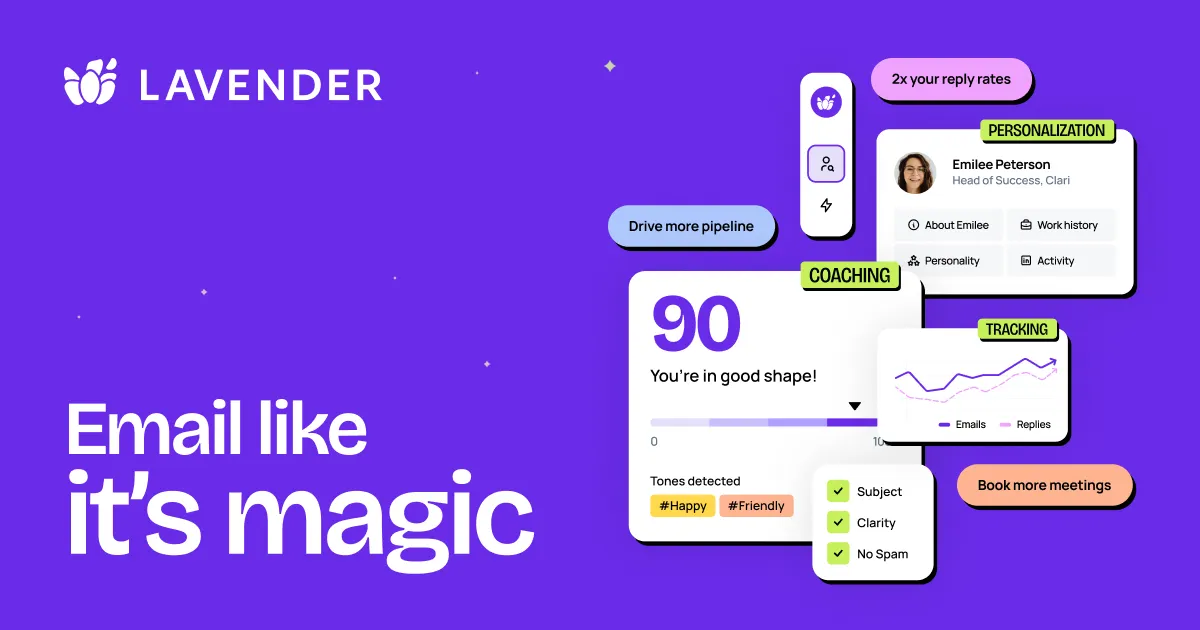

Lavender is aimed at a narrow but painful problem: writing cold and follow-up emails that people actually reply to. Rather than generating a message and walking away, it sits in your compose window and coaches the draft while you type. Three situations show where that approach earns its place:
- An SDR sending high volumes of cold outreach. When you are writing dozens of prospecting emails a day, small habits, walls of text, weak subject lines, self-centered phrasing, quietly drag down reply rates. Lavender scores each draft and flags these issues before you hit send, so the feedback loop happens in seconds instead of weeks after a campaign underperforms.
- An account executive personalizing a first-touch email to a specific buyer. Generic templates are easy to ignore. Lavender's assistant is built to pull context about the prospect into the draft so the opening line references something real, which is the difference between an email that reads as bulk send and one that reads as written for the recipient.
- A sales manager trying to coach a team at scale. Reviewing every rep's outbound manually does not scale past a handful of people. Lavender's team analytics surface who is writing well and where coaching is needed, turning email quality into something a leader can actually measure and improve.
How the coaching actually works
The core of the product is the Email Coach, a Chrome extension that layers onto your existing inbox. As you write, it produces a running score and specific, actionable notes, on length, tone, structure, readability, and subject line, rather than a vague grade. This real-time model is the whole point. Most writing tools tell you a message failed after the fact; Lavender's value is that it intervenes at the moment you can still change the outcome. The feedback is opinionated by design, and the underlying suggestions are informed by the company's analysis of a very large volume of emails to identify patterns that correlate with replies.
Alongside the scoring, Lavender offers AI drafting. On the site the company positions this as writing "like a top seller," and it now packages a broader AI sales agent, called Ora, that can draft outreach and handle CRM enrichment. For a rep, the practical benefit is a faster starting point: instead of staring at a blank message, you get a draft you then refine against the score. The tradeoff worth being honest about is that AI-generated openers still need a human to verify the personalization is accurate, an email that confidently references the wrong detail is worse than a plain one.
The vendor's own materials also describe a personalization assistant that surfaces prospect information, a subject-line analyzer, and a mobile preview so you can see how a message renders on a phone. These are consistent with the product's positioning but are not independently confirmed on the pages I could reach, so treat them as vendor-described rather than benchmarked. What I could confirm on the site is the real-time scoring, the AI drafting, team analytics, and that Lavender is SOC 2 certified and GDPR compliant, which matters if your outreach touches EU contacts or your security team has to sign off before rollout.
Because it runs as a browser extension inside the inbox, it fits naturally with Gmail and Outlook workflows. The existing product write-up lists native connections to sales engagement platforms such as Salesloft and Outreach and to HubSpot; I could not verify those specific integrations on the site's live pages, so confirm the ones your stack depends on directly with the vendor before committing. Lavender also runs a free training track, its "Email Wizard" course and a library of videos, which is a reasonable signal that the company treats email quality as a skill to teach, not just a score to display.
Who should consider it, and who probably should not
Lavender is built for B2B sales roles that live in cold and semi-cold email: SDRs, BDRs, account executives, and the leaders who manage them. If your revenue depends on outbound reply rates and you send enough volume that a few percentage points of improvement is meaningful, the real-time coaching is directly relevant, and the manager analytics give a team lead a way to coach consistently.
It is a weaker fit outside that context. If you write mostly internal email, transactional messages, or long-form nurture content, a scoring engine tuned for short sales outreach will fight you more than help. Solo founders who send only a handful of emails a week may not send enough to justify a paid seat. And teams standardized on an email client or CRM that Lavender does not support will get less value, which is exactly why verifying integrations up front matters. You can compare it against other options in the AI email writer category before deciding.
What it costs
Lavender uses a freemium model. There is a free tier that lets you install the Chrome extension and try the scoring with a limited number of analyses, and paid individual and team plans that unlock fuller usage and manager-level analytics. The vendor does not publish specific per-seat prices or the exact free-plan analysis cap on the pages I could access, so I am not going to quote a number. Anyone budgeting for a team rollout should request current pricing directly and confirm whether analytics and the AI drafting features they want are in the tier they are pricing. The free tier is genuinely useful for evaluation: you can install it and see whether the scoring changes how your reps write before spending anything.
The honest drawbacks
The scope is deliberately narrow. Lavender coaches sales email; it is not a general writing assistant, a full sequencer, or a replacement for a sales engagement platform. Its scoring is also opinionated, which is a strength for consistency but can feel prescriptive if your audience or industry rewards a different style, treat the score as guidance, not gospel. The AI drafting shares the reliability caveat of any generative tool: it accelerates a first draft but does not remove the need to fact-check personalization. And the lack of published pricing and a live, verifiable integrations list adds friction to evaluation; you will have to talk to the vendor to close those gaps.
Where it lands
For sales teams whose numbers hinge on outbound email, Lavender occupies a defensible niche: in-the-moment coaching that changes writing behavior, plus analytics that let a manager scale that coaching. The features I could verify, real-time scoring, AI drafting, team analytics, and SOC 2 / GDPR compliance, back up that positioning. The gaps are around transparency: pricing and some integrations and secondary features are documented by the vendor rather than independently confirmed here. If cold-email reply rate is a metric you are actively trying to move, the free tier is a low-cost way to test whether Lavender's approach works for your team; if email is peripheral to your role, it is easy to skip. Browse related options in the full tool directory or read more comparisons on the blog.