How to Choose the Right AI Framework: A Developer's Honest Guide
A developer's honest, story-driven guide to choosing the right AI framework, with real lessons on TensorFlow, PyTorch, JAX, LangChain and more.
How to Choose the Right AI Framework: A Developer's Honest Guide
Let me tell you about the worst week of my engineering year. We had just shipped a model into production, the demo had wowed everyone, and then reality arrived. The framework we picked because it was trending could not deploy cleanly to the edge devices our customers actually used. We spent the next three weeks bolting on workarounds, drinking too much coffee, and quietly questioning our life choices. That is when I learned, the hard way, that figuring out how to choose the right AI framework is less about which tool is coolest and more about which tool fits the messy reality of your project. That lesson is the reason this guide exists, and I am going to walk you through it the way I wish someone had walked me through it.
Here is the thing nobody tells you when you start: there is no single best framework, and anyone who insists there is probably has not shipped enough projects. I have used TensorFlow when the deployment story mattered most, leaned on PyTorch when I wanted to think clearly and iterate fast, watched a teammate fall head over heels for JAX during a research sprint, and reached for scikit-learn more times than I can count when the problem was honestly just tabular data wearing a fancy hat. Each of those was the right call in its moment and would have been the wrong call in another. The framework is a tool, and tools earn their place by fitting the job, not by winning a popularity contest on social media.
So instead of handing you a ranking, I want to hand you a way of thinking. We are going to talk about what these frameworks actually are, in plain language, and why the choice quietly shapes everything from your stress levels to your cloud bill. I will give you my honest take on the big players in 2026, the ones I reach for without hesitation and the ones I avoid for certain jobs. Then we will get practical: the factors I genuinely weigh, a cheat-sheet table I keep in my head, the exact steps I follow before committing, the mistakes I have personally made so you do not have to repeat them, and my go-to picks for the kinds of projects that keep landing on my desk.
I will also be honest about the emotional side of this, because it is real and it trips up smart people constantly. Engineers get attached to tools. We defend our favorites on the internet like they are sports teams, and we quietly judge people who chose differently. But the best developers I know hold their frameworks loosely. They pick the right one for the job, ship it, and move on, instead of forcing every problem to fit the tool they happen to like best. That mindset, more than any specific framework, is what separates a smooth project from the kind of three-week firefight I lived through.
By the time we are done, you will not just know the names of the frameworks. You will know how to look at a new project, size it up honestly, and pick a tool you will not resent in three months when you are deep in production and the deadline is breathing down your neck. That is the goal. Not the trendiest answer, but the one you can live with at two in the morning when something breaks. Grab a coffee, and let us get into it together.
What Is an AI Framework and Why Does It Matter?
Picture building a house. An AI framework is the set of power tools, lumber, and blueprints that lets you build without forging your own nails. Technically, it is a collection of libraries that handle the gnarly parts of machine learning for you: the calculus of gradients, the math that runs fast on your GPU, the prebuilt neural network pieces, the plumbing that feeds data in and serves predictions out. Without a framework, you would be writing all of that by hand, and trust me, you do not want to spend your one wild and precious life debugging hand-rolled matrix math at midnight.
The frameworks live at different heights, which confused me for years until it finally clicked. Down at the foundation you have the deep learning heavyweights, TensorFlow, PyTorch, and JAX, where you get total control and total responsibility. A floor up sits Keras, which is like a really good contractor who handles the details so you can focus on the design. Off to the side is scikit-learn, the reliable old toolbox for everything that is not deep learning, which honestly covers a huge chunk of real work nobody likes to admit. And up on the top floor are the newer tools, Hugging Face, LangChain, and LlamaIndex, that let you snap together models other people already trained, like prefab rooms you just drop into place.
Why does any of this matter to you personally? Because the framework you pick is the thing you will stare at every single day. It decides how your days feel. A framework that fits your brain makes you fast and happy; one that fights you makes every bug a slog and every Monday a little heavier. It decides your bill. A framework that wrings every drop of performance out of your hardware can save real money, and an inefficient one quietly burns it while you are not looking. It decides who you can hire. Pick something obscure and you will struggle to find teammates; pick something popular and there is a whole community ready to answer your three a.m. questions before you have even finished typing them.
And here is the part that stings: switching later is brutal. I have lived through a migration, and your models, your training code, and your serving setup all get tangled up in one framework's way of doing things like roots growing into a wall. Tearing that apart and rebuilding it somewhere else eats months and morale. That is why I treat the choice with respect now, the same way I would choosing a database or a cloud provider. Get it roughly right up front and the framework fades into the background where it belongs, quietly doing its job while you build the thing you actually care about and get to go home on time.
Top AI Frameworks in 2026 Compared
Here is my honest, lived-in take on the big players. Think of this as the advice I would give you over coffee, not a sterile spec sheet written by a marketing department.
TensorFlow
TensorFlow is the framework I reach for when getting the model out the door, onto phones, edge devices, and servers, matters more than anything else in the room. What I love: the deployment story is unbeatable and it scales like a champ inside big companies with serious ops teams. What bugs me: it has a learning curve, and over the years the API has shifted enough to make me grumble into my keyboard. Great for production, a little less fun for late-night tinkering.
PyTorch
PyTorch is my comfort food. Writing models feels like writing regular Python, and when something breaks I can actually see why instead of squinting at a cryptic graph. What I love: it is intuitive, the community is enormous, and you are never alone with a problem for long. What bugs me: mobile deployment used to be a chore, though that gripe has mostly faded these days. If I am starting fresh, this is usually where I begin without much agonizing.
JAX
JAX is the framework my research friends rave about until I have to gently change the subject. It is blisteringly fast and elegant if you think in functions. What I love: raw performance, especially on TPUs, and a genuinely beautiful design for novel ideas. What bugs me: the functional style took my brain a while to absorb, and the ecosystem is smaller. Brilliant for the bleeding edge, overkill for the everyday app.
Keras
Keras is what I recommend to friends just starting out who do not want to cry. What I love: you can build a working model in a handful of readable lines and feel like a wizard. What bugs me: when I want to do something weird and custom, I sometimes hit a ceiling and have to drop down a layer. Perfect for learning and quick prototyping.
scikit-learn
scikit-learn is the unsung hero of my career. So many problems I have been handed turned out to be plain old tabular data, and this is the tool for that. What I love: clean API, fantastic docs, and you do not even need a GPU. What bugs me: nothing, honestly, as long as you do not ask it to do deep learning, which is simply not its job.
Hugging Face Transformers
Hugging Face is how I get an NLP prototype running before lunch and still have time to eat. What I love: a giant library of pretrained models you can grab and fine-tune instead of starting from zero. What bugs me: the convenience can hide details that come back to bite you in production, and big models cost real money to run at scale.
LangChain
LangChain is my go-to when I am wiring a language model into an actual app with tools and multiple steps. What I love: it gets an agent working fast and connects to seemingly everything. What bugs me: the API changes often enough to keep me on my toes, and for simple jobs it can be more machinery than I actually need.
LlamaIndex
LlamaIndex is the one I reach for when I need a model to answer questions from my own pile of documents. What I love: it makes feeding your data to a model genuinely painless. What bugs me: it overlaps with LangChain, so I have to stop and decide which one is really doing the heavy lifting before I tangle them together.
AutoML Platforms
AutoML platforms are what I suggest when a team has a real problem but not much ML experience and no time to grow some. What I love: you point it at your data and it figures out a decent model on its own. What bugs me: you trade away control, you can get locked in, and the meter is always quietly running in the background.
Key Factors to Consider When Choosing an AI Framework
When a new project lands on my desk, here are the questions actually running through my head, in roughly the order I ask them while I pretend to look thoughtful.
What am I really building? This is the big one, the question that quietly answers most of the others. If it is deep learning research, I am thinking PyTorch or JAX. If it is tabular data, scikit-learn. If I am building on top of a language model, Hugging Face, LangChain, or LlamaIndex. Get this match wrong and nothing else saves you, no matter how nice the docs are.
What does my team already know? I have watched a brilliant framework grind a great team to a halt because nobody knew it and the deadline did not care. If my crew lives in PyTorch, dragging them into JAX's functional world has a real cost in lost weeks. I respect what people already have in their hands.
Will I be alone when things break? At two in the morning, with a bug I cannot explain and a launch I cannot move, a big community is my best friend. I check how active the project is and how many people have hit my exact problem before me. A lively ecosystem is a safety net I have fallen into gratefully more than once.
Will it keep up? I think about whether the framework can grow from my laptop prototype to a real production load without forcing a humiliating rewrite. I would much rather find that out now, calmly, than during a launch with everyone watching.
Where does this thing have to live? Phone, browser, edge box, server. I learned this one the hard way, remember the worst week. Now I ask about deployment before I write a single line of training code, because falling in love with a model you cannot ship is a special kind of heartbreak.
What will it cost me, really? Not just the price tag, but the GPU bills, the platform fees, and the hours my team will spend keeping it alive at three in the morning. A free framework that needs five engineers can cost far more than a paid one that needs a single calm person.
AI Framework Comparison: Use Case Decision Guide
This is basically the cheat sheet I keep in my head, finally written down. When someone describes their project in one breathless sentence, this is how I instinctively route them before I have even finished my coffee.
| If you are building... | I would reach for... | Because... |
|---|---|---|
| Bleeding-edge research models | PyTorch or JAX | You need flexibility and speed to try wild ideas |
| A serious enterprise production system | TensorFlow | Its deployment and ops story is rock solid |
| Anything on tabular data | scikit-learn | It is the right-sized tool, no deep learning needed |
| Your first real model | Keras | You will get something working fast and stay sane |
| An LLM-powered app or agent | LangChain | It wires models, tools, and steps together quickly |
| A bot that answers from your docs | LlamaIndex | It makes feeding your data to a model painless |
| Something with a pretrained model | Hugging Face | You can grab and fine-tune instead of starting over |
| A model with a tiny ML team | AutoML platform | It does the heavy lifting you do not have staff for |
I want to be clear, though, because I have been burned by my own cheat sheet: this table is where I start a conversation, not where I end it. The single sentence someone gives me almost never captures the constraint that ends up mattering most, the weird edge device, the existing pipeline held together with duct tape, the budget that is half what they hoped. So I use the cheat sheet to get to two or three candidates fast, and then I do the thing that actually settles it, which is build something small in each and feel how it goes. That step has saved me from every framework regret I would otherwise have collected.
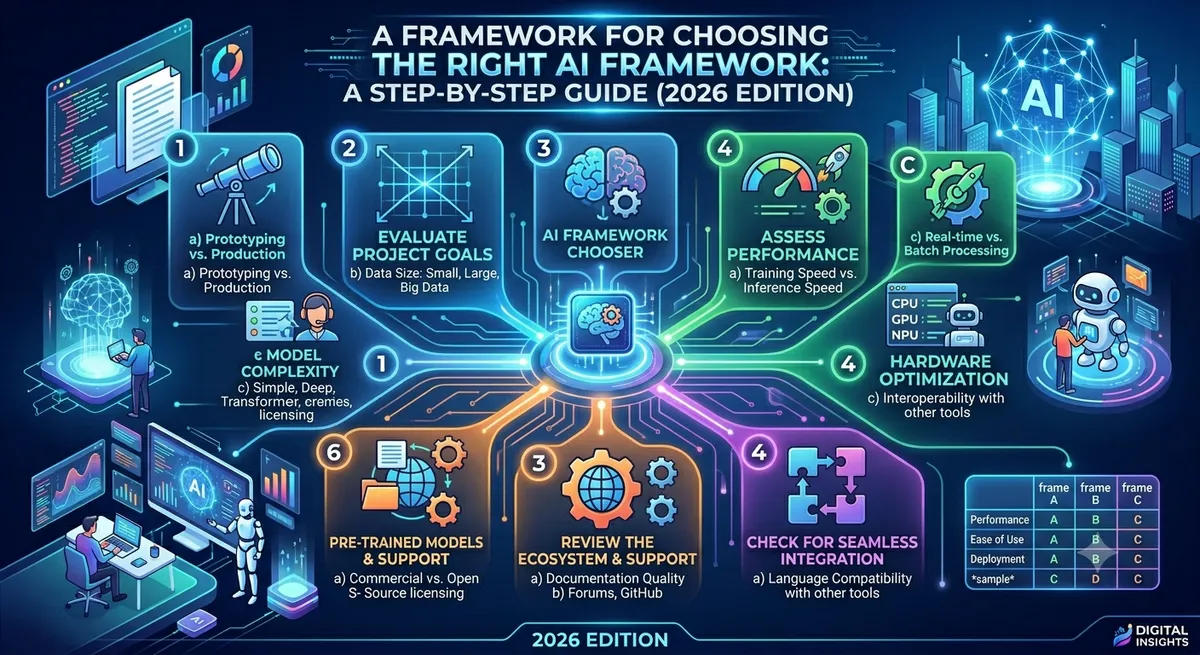
Step-by-Step: How to Evaluate and Choose Your AI Framework
Here is the actual routine I run now, hard-won from that bad week and a few smaller scrapes since.
- Write down what I really need. Problem type, the data I have, how fast it must respond, where it will run, and what I can spend. Vague requirements are exactly how you end up resenting your choice three months later.
- Find the deal-breakers. I separate the must-haves, like it has to run on this specific phone, from the nice-to-haves. Deal-breakers kill options fast, and honestly that is a relief.
- Pick two or three to try. I use my cheat sheet to get a short list. I do not try to test everything under the sun; that way lies analysis paralysis and a missed deadline.
- Build a tiny real thing in each. This is the step that matters most, the one I will defend with my dying breath. A small slice of the actual problem tells me more than any blog post, including this one you are reading.
- Measure it on real hardware. I check training time, response speed, and resource use on something like what production will actually be. I trust my own numbers over anyone's glossy claims.
- Ask my team how it felt. The people who will live in the code every day get a real vote on readability and how painful the debugging was. Their daily comfort adds up fast.
- Check if it will still be around. I look at how active the community is and whether the maintainers seem committed for the long haul, because I am making a multi-year bet.
- Add up the true cost. Compute, fees, and human hours, over a realistic stretch of time, not just the sunny first month before the bills arrive.
- Decide, then write down why. I make the call and jot down my reasoning, plus what would make me change my mind later. Future me, tired and skeptical, is always quietly grateful.
The whole thing takes maybe one to three weeks, which feels slow until you remember that my bad choice cost a full month of cleanup and a chunk of my sanity. The little proof of concept is the part I will never, ever skip again, because it shows you the unvarnished truth that no comparison table or confident blog post can.
Common Mistakes When Choosing an AI Framework
Every one of these is a mistake I have either made myself or watched a good friend make up close. Learn from our collective pain so you can make fresh, more interesting mistakes of your own.
Chasing the shiny thing. I picked a trending framework once purely because it was everywhere online and the demos looked magical. It was the wrong tool for my actual problem, and the magic wore off by the second week. Hype is not a requirement, no matter how loud it gets.
Forgetting where it has to run. This was my famous bad week in a nutshell. I fell in love with the training experience and ignored deployment until it was far too late to back out gracefully. Now I ask about the destination first, every single time.
Pretending the learning curve is free. I have seen a team lose weeks ramping up on a paradigm nobody knew, all for performance they did not even need in the end. Count the ramp-up time as a real, line-item cost, because your calendar certainly will.
Reaching for a sledgehammer. Sometimes a couple of direct API calls is the whole answer, and wrapping it in a heavy framework just adds more things that can break at midnight. Use the simplest tool that genuinely works, and resist the urge to look sophisticated.
Only looking at the sticker price. A buddy chose the free option to save money and then quietly drowned in compute bills and maintenance toil. Free is rarely free; add it all up before you celebrate the savings.
Treating the choice as forever. The landscape moves fast, faster than our habits do. I revisit my big choices now without shame, because the right answer last year might be wrong today, and admitting that early is a strength, not a failure.
Best AI Frameworks for Specific Use Cases
If you just want my gut call for the projects that show up on my desk most often, here it is, no hedging.
Natural Language Processing. I start with Hugging Face almost every single time because the model I want is probably already sitting there waiting for me. When I am building a full app around a language model, LangChain handles the wiring and LlamaIndex handles answering from my own documents. PyTorch is quietly underneath it all if I ever need to train something from scratch.
Computer Vision. PyTorch is my default for anything vision, because the research and the libraries are all right there at my fingertips. But the moment the model has to live on a phone, I stop and look hard at TensorFlow, which has genuinely earned its keep on devices over the years.
Autonomous Agents. For anything that has to plan and call tools across multiple steps, LangChain is where I go first, and I lean on LlamaIndex when the agent needs to reason over a big pile of my own knowledge. Both sit comfortably on top of existing models, so I am composing, not training, which keeps me focused on the actual product.
Time-Series Forecasting. For everyday business forecasting, I am usually happiest with scikit-learn and the classic statistical tools, because they are honest, simple, and easy to explain to a skeptical stakeholder. When the patterns get genuinely gnarly, I reach for PyTorch, and when nobody on the team has the time or the expertise, an AutoML platform gets a respectable answer with almost no effort at all.
Frequently Asked Questions
What is the best AI framework for beginners?
If you are just starting out, I point you at Keras or scikit-learn every single time, no debate. Keras lets you build a neural network in a few readable lines and actually feel good about it, and scikit-learn is perfect for classic problems on tabular data. Both have friendly docs and let you focus on learning instead of fighting your tools, which is exactly what you want before the frustration scares you off the field entirely.
Should I pick TensorFlow or PyTorch in 2026?
Honestly, you really cannot go wrong with either one anymore, so relax. I lean PyTorch when I am starting fresh because it feels like writing normal Python and the community has my back at all hours. I lean TensorFlow when getting the model onto phones, edge devices, and servers is the whole point of the project. Pick based on your actual project, not on the internet's endless, exhausting arguments.
Do I really need a deep learning framework?
Probably less often than you think, and that is good news for your timeline. So many problems I have been handed were just tabular data in disguise, and scikit-learn solved them faster and cheaper than any deep learning setup ever could have. Save the heavy frameworks for when the problem genuinely needs neural networks, like images, language, or big messy unstructured data that classical methods choke on.
What is the difference between LangChain and LlamaIndex?
The way I keep them straight in my own head: LangChain is the general toolkit for building language model apps, agents, and multi-step flows, while LlamaIndex is the specialist for getting a model to answer from your own data. They overlap, sure, and I often use both together, with LlamaIndex quietly feeding the data and LangChain running the show up front. Pick based on which job is the heart of your product.
Are AutoML platforms actually worth it?
For a team with a real problem and not much ML experience, yes, they are genuinely a gift. You point them at your data and get a working model without needing deep expertise on staff. The catch is less control, possible lock-in, and a meter that keeps running whether you look at it or not, so strong teams tend to outgrow them eventually. Match the tool to where you actually are today, not where you hope to be.
How much does community support really matter?
More than you would ever guess until your first three a.m. bug stares back at you silently. A big, active community means someone has probably already hit your exact problem and kindly posted the fix while you slept. When two frameworks are close on everything else, I pick the one with the livelier community every time, because it quietly saves me hours and a few gray hairs.
Can I switch frameworks later if I regret my choice?
You can, but I have done it and it genuinely hurts, so do not count on it as an easy escape hatch. Your models, training code, and serving setup all get welded to one framework's habits over time, so pulling them apart and rebuilding elsewhere can eat months you did not budget. That is exactly why I spend a calm couple of weeks up front and build a small test, so I almost never have to switch at all.
Which framework is best for putting a model on a phone?
This is the exact one that burned me, so listen closely. TensorFlow has long had the most polished story for getting models onto mobile and edge devices, though PyTorch has genuinely caught up a lot lately. If your model absolutely has to live on a phone, build that export-and-run pipeline early, before you fall hopelessly in love with a model you simply cannot ship to anyone.
How long should choosing a framework take?
Give it one to three weeks and resist the urge to rush. That window covers writing down what you need, building a tiny version in two or three candidates, measuring them honestly, and writing down your decision for future you. It feels slow in the moment, I know, but it is absolutely nothing compared to the month I once lost cleaning up after rushing the choice to look fast.
Should I bother learning more than one framework?
If you want to grow as a developer rather than stall, then absolutely yes. Knowing a few frameworks makes you flexible and helps you make smarter calls instead of forcing every poor problem into your one favorite tool. My honest advice: get really good at one deep learning framework, keep scikit-learn in your back pocket for the tabular jobs, and pick up the app-layer tools like LangChain as the projects actually demand them.
Conclusion
If you remember one thing from all my rambling, let it be this: there is no single right AI framework, only the right one for the project sitting in front of you, and the developer who quietly accepts that ships smoother projects than the one who picks a favorite and forces every problem to fit it. I have used most of these tools in anger, TensorFlow, PyTorch, JAX, Keras, scikit-learn, Hugging Face, LangChain, LlamaIndex, and the AutoML platforms, and every one of them was the hero in some project and the villain in another, sometimes in the same month.
So do what I do now, born of one genuinely terrible week and a stubborn refusal to repeat it. Write down what you really need, find the deal-breakers, shortlist two or three, and build a tiny real thing in each before you commit your heart to anything. Measure it on real hardware, ask your team how it felt to work in, and add up the true cost, not just the friendly sticker price. Then decide, write down why, and stay humble enough to revisit it when the landscape inevitably shifts under your feet. Hold your tools loosely, match them honestly to the job, and the framework will quietly do its work while you build the thing you actually set out to build. That, far more than any trendy answer, is how you choose well and sleep at night.
Want to stay updated?
Get the latest AI tool reviews and news delivered to your inbox.