What Is AI? A Simple Guide for Beginners in 2026
New to AI? Here's a clear, no-jargon explanation of what artificial intelligence actually is, how it works, and which tools to try first.

"AI" gets thrown around so often now that it's easy to nod along without actually knowing what it means. If you've been wondering what AI actually is — not the sci-fi version, the real thing you're probably already using — this guide breaks it down in plain language.
What Is AI, in Plain English?
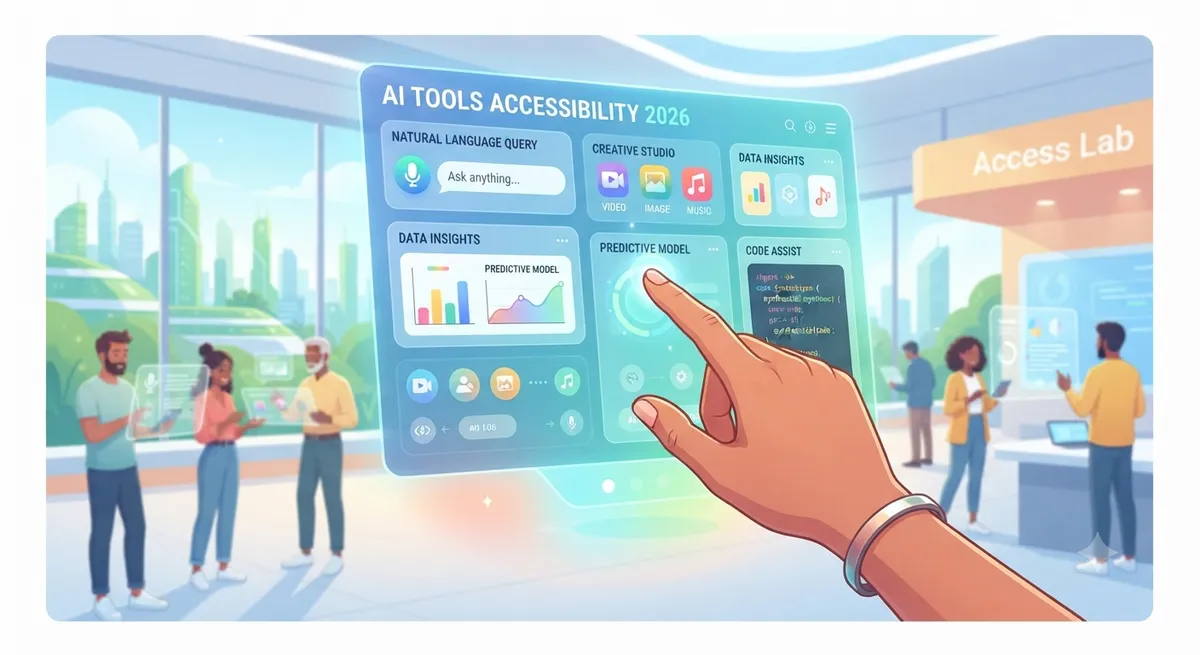
Artificial intelligence is software trained to recognize patterns in huge amounts of data and use those patterns to perform tasks that normally require human thinking — understanding language, recognizing images, making predictions, or generating new content. Modern AI doesn't "think" the way humans do; it's more accurate to say it's extremely good at predicting what comes next based on everything it learned during training.
How Tools Like ChatGPT Actually Work
Tools like ChatGPT, Gemini, and Claude are built on large language models (LLMs) — AI systems trained on massive amounts of text to predict the most likely next word in a sequence, one word at a time, based on everything that came before it. Trained on enough text, this simple prediction process produces surprisingly coherent, useful, and often creative responses. It's not "understanding" in the human sense, but the output is frequently good enough to be genuinely useful for writing, research, and problem-solving.
The Different Types of AI You'll Encounter
- Chatbots and assistants — ChatGPT, Gemini, and Claude, built for conversation, writing, and general problem-solving.
- Image generators — tools that create original images from text descriptions.
- Coding assistants — AI built specifically to write, explain, and debug code.
- Voice and video AI — tools that generate speech, transcribe audio, or create video from text and images.
- Recommendation systems — the quieter, older form of AI powering product suggestions on sites like Amazon and Netflix.
What AI Can Actually Do Well
Modern AI genuinely excels at drafting text quickly, summarizing long documents, answering general questions, generating images and basic code, and spotting patterns in large datasets faster than a human could manually. For everyday tasks — writing an email, brainstorming ideas, explaining a concept — today's AI tools are reliable enough to be a real time-saver.
Where AI Still Falls Short
AI models can confidently state incorrect information — a limitation known as hallucination — because they're generating statistically likely text, not verified facts. They also lack genuine understanding of context the way a human does, can reflect biases present in their training data, and generally struggle with tasks requiring real-world, up-to-the-minute knowledge unless specifically connected to live data sources like web search.

AI vs Machine Learning vs Generative AI: What's the Difference?
These terms get used interchangeably, but they're not quite the same thing. Artificial intelligence is the broad field — any system designed to perform tasks that would normally require human intelligence. Machine learning is a subset of AI focused specifically on systems that improve through exposure to data rather than explicit programming. Generative AI is a further subset of machine learning focused on producing new content — text, images, audio, video — rather than just analyzing or classifying existing data.
Where to Start If You've Never Used AI Tools Before
The easiest entry point for most beginners is a general-purpose chatbot like ChatGPT or Google's Gemini — both have solid free tiers and require no technical setup. Start with everyday tasks: drafting an email, summarizing an article, or asking it to explain something you're curious about. Once you're comfortable, specialist tools for writing, coding, or image generation become worth exploring for more specific tasks. Our best free AI tools guide is a good next step for beginners ready to explore further.
Common Myths About AI, Cleared Up
AI is not conscious or self-aware, despite how convincingly it can hold a conversation — it's a statistical prediction system, not a thinking entity. AI also isn't going to replace every job overnight; it's proving most useful as a tool that speeds up specific tasks within a job, rather than a wholesale replacement for human judgment. And "free" AI tools aren't a trick — many genuinely have no-cost tiers, though usage limits typically apply.
Getting Comfortable With AI Terminology
A handful of terms come up constantly once you start using AI tools regularly: prompt (the instruction you give an AI), hallucination (confidently wrong output), context window (how much information an AI can "remember" within one conversation), and fine-tuning (further training a model for a specific task). Knowing these basics makes it much easier to understand what different AI tools are actually claiming to do.
Frequently Asked Questions
Is AI the same thing as ChatGPT?
No, ChatGPT is one specific AI tool built on a large language model. AI is the much broader field that includes chatbots, image generators, recommendation systems, and many other technologies.
Do I need technical skills to use AI tools?
No, most consumer AI tools like ChatGPT and Gemini are designed for plain-language use with no technical background required.
Is AI always accurate?
No, AI models can generate confidently incorrect information, so it's good practice to verify important facts independently, especially for anything high-stakes.
What's the best free AI tool for a complete beginner?
ChatGPT or Google's Gemini are the most beginner-friendly starting points, since both handle general questions and everyday tasks without any setup.
Final Thoughts
AI isn't magic — it's pattern recognition at a massive scale, packaged into tools that are genuinely useful for everyday tasks once you understand their strengths and limits. Ready to try some? Browse the full AI tools directory on AI List Stack to find beginner-friendly options by category.
Want to stay updated?
Get the latest AI tool reviews and news delivered to your inbox.