I Tested 7 AI Logo Generators for My Startup — Here's What I Actually Found
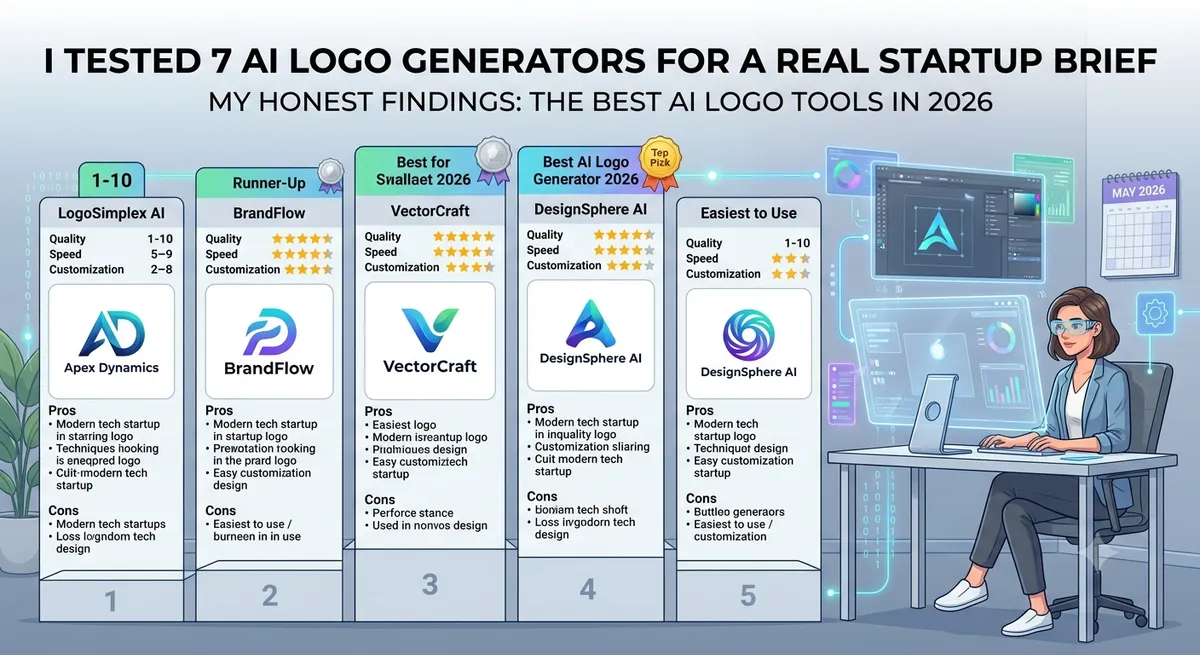
I spent two weeks testing 7 AI logo generators for a real startup brief. Here are my honest findings on which best ai logo generator tools deliver in 2026.
I Tested 7 AI Logo Generators for My Startup — Here's What I Actually Found
When I launched my second SaaS product earlier this year, I made a deliberate decision I had avoided the first time around: I would not hire a designer for the initial logo. Not because I do not value design — I do, considerably — but because I wanted to understand exactly how far the best ai logo generator tools had come before allocating budget to a specialist. What followed was two weeks of daily testing across seven platforms, hundreds of generated variations, and some genuinely surprising findings about where AI-assisted brand identity stands in 2026. This is my honest account of the whole experiment.
The Setup: What I Was Testing Against
I gave every tool the same brief. The product is a B2B analytics dashboard called Vanta (placeholder name), targeting mid-market finance teams. The brand direction I had in mind was clean, geometric, and serious — dark navy as the anchor color, no gradients, no rounded bubbly aesthetics. Something that would not look out of place in a procurement conversation at a mid-sized company. I set myself a ceiling of $100 and gave each platform the same inputs: brand name, industry (financial software), style preference (minimal, geometric, professional), and color guidance (navy and white).
My three pass/fail criteria were: the output must look professionally designed without needing me to explain it; it must include a vector file (SVG or EPS) in the paid tier; and the commercial rights must be unambiguously full and transferable. Everything else was comparative.
Looka: The Reliable Starting Point
I began with Looka because it appears at the top of virtually every roundup, and I wanted to calibrate my expectations before testing less-known tools. The onboarding flow is well-designed — you select your industry, pick style tiles, choose a color palette, and indicate layout preferences before seeing any results. Within about a minute, Looka generated a grid of roughly 50 concepts. Around eight of them were genuinely good. That pass rate surprised me.
The editor is where Looka earns its strong reputation. I spent approximately 25 minutes in the editor swapping font pairings from a large library, adjusting the navy hex values, changing the icon, and previewing the mark across mockup contexts: business card, app icon, email header, and a storefront sign. The final SVG I exported opened cleanly in Illustrator with editable paths and text layers intact. That is not a given across tools at this price point.
One honest criticism: the icon library, while extensive, has a familiarity problem. In my first batch of results, two icon marks looked close to logos I had seen on other platforms during previous tests. If you are building a brand in a competitive visual space, do not accept the first-page results. Push to page three or four, adjust your style inputs, and run additional batches before committing to a direction.
Adobe Firefly: Best Results, Highest Skill Requirement
I am an existing Adobe Creative Cloud subscriber, so Firefly cost me nothing beyond what I was already paying. The value proposition here is different from every other tool in this list: rather than guiding you through a structured brand brief flow, Firefly puts a powerful generative model in your hands within the Adobe environment. The output quality ceiling is the highest of anything I tested across the two weeks. I generated marks that did not look like anything I had encountered on other platforms — genuinely original geometric forms that matched the brief closely.
The catch is significant: Firefly assumes you know what to do with the output once it exists. Pulling the generated mark into Illustrator for vector refinement is straightforward if you know Illustrator. If you do not, the tool is considerably less useful than Looka or Canva for a non-designer working alone. I spent more time in the generation and refinement loop with Firefly than with any other tool — probably three hours total across multiple sessions — but the end quality was the highest of the entire test. My recommendation: if you or anyone on your team has Illustrator competency, Firefly should be your first stop, not your last.
Canva AI: Perfect for Some Brands, Wrong for Mine
I already use Canva extensively for social media assets, so slotting the logo generation feature into my existing workflow was straightforward. Canva's outputs are polished, immediately usable for digital contexts, and easy to iterate quickly within the browser. The platform excels at accessible, approachable aesthetics — rounded forms, friendly color palettes, layouts that communicate warmth and openness.
That aesthetic direction was the problem for my specific brief. A B2B analytics tool targeting finance teams needs to project precision and seriousness, not approachability and warmth. Every batch I generated with Canva leaned toward consumer-friendly visual language regardless of how I adjusted the style inputs. The tool is not doing anything wrong — it is optimized for a different brand territory than the one I needed. For a consumer app, a lifestyle brand, or a content creator identity, I would probably start with Canva over Looka. Context matters here more than absolute quality rankings.
A secondary issue: accessing vector output from Canva requires navigating more steps than competing tools. PNG is the default export; SVG is available on Canva Pro but the workflow is less direct. For professional use where vector files are mandatory, the friction adds up across multiple iteration cycles.
Tailor Brands: Think Beyond the Logo
Tailor Brands reframed my mental model of what an AI logo platform can be. I went in expecting a logo tool and came out treating it more like a brand operating system. The platform moves you from logo generation to brand kit to business card layouts to a social media template library to a basic website builder — all within a single subscription. For someone building a brand from zero, the all-in-one packaging reduces context-switching significantly.
The logo quality itself was solid — comfortably above free tools, a notch below Looka in terms of raw mark refinement. What Tailor Brands delivers in breadth compensates for that in most practical contexts. If I were launching a service business, a retail concept, or a professional practice rather than a SaaS product, Tailor Brands would be a serious contender for the primary tool. The value equation changes when you price in all the downstream brand assets the subscription includes.
Brandmark: The Quiet Overachiever
Brandmark was the biggest positive surprise of the test. It does not market itself as aggressively as the category leaders, has a simpler interface, and costs less than most competitors. But the raw output quality for geometric, minimal, B2B aesthetics is exceptional. In my first batch of results, three marks appeared that I would have been comfortable putting directly into a pitch deck. The model seems genuinely tuned for clean, abstract marks rather than icon-heavy decorative logos.
The pricing model is a one-time fee that includes SVG files, all color variants (full color, black, white), favicon, and full commercial rights. No subscription, no monthly fee, no upsell to unlock the vector file. The in-browser editor is more limited than Looka's — you can adjust colors and fonts but not reposition icon elements — so plan to open the SVG in a vector editor for more substantial modifications. As a starting point for a tech or professional services brand, Brandmark consistently punches above its price.
LogoAI: Functional but Unremarkable
LogoAI is competent in all the ways that matter for a low-stakes project and unremarkable in the ways that matter for a primary commercial brand. The generation is fast, the interface is clean, and the output is workable. What I did not find was surprise or delight — no marks that made me stop scrolling. Every result felt like something I had already seen somewhere, assembled from a reliable but finite visual vocabulary.
I would recommend LogoAI for internal tools, side projects, event identities, or community initiatives where a quick professional-looking mark is the goal and long-term brand distinctiveness is not a priority. For a business you are building seriously over a multi-year horizon, the category leaders produce meaningfully better starting material.
Designs.ai: Built for Professionals Managing Multiple Brands
Designs.ai is clearly designed for agencies or in-house teams handling multiple brand projects in parallel rather than solo founders working on a single identity. The interface offers more configuration than consumer-facing tools, the brand management layer is stronger, and the export format options are comprehensive. My experience generating a single logo was slightly less streamlined than on Looka or Brandmark — more steps, more decisions at each stage — but the output quality was professional and the files were immediately production-ready.
For an agency running five or ten brand projects simultaneously, Designs.ai makes considerable sense as a production tool. As a solo founder optimizing for speed on one project, it felt slightly over-engineered for my use case. Match the tool to your operational context.
What I Actually Used and What I Learned
After two weeks of testing, I ended up using a Looka-generated mark as the starting point and refined it in Illustrator for approximately 45 minutes. The Brandmark output was a close second that I returned to several times. Adobe Firefly produced the most distinctive raw mark of the entire test, but the time investment to bring it to final quality exceeded the scope of this experiment.
| Tool | Output Quality | Vector File | Commercial Rights | Best Fit |
|---|---|---|---|---|
| Looka | Strong | Yes (paid) | Full (paid) | Small business, SaaS founders |
| Adobe Firefly | Excellent | Yes | Commercial safe | Designers in Adobe CC |
| Canva AI | Good | Limited (paid) | Full (paid) | Consumer brands, content creators |
| Tailor Brands | Good | Yes (paid) | Full (paid) | Full brand launch packages |
| Brandmark | Strong | Yes | Full | Tech, B2B, minimalist aesthetics |
| LogoAI | Adequate | Yes (paid) | Full (paid) | Low-stakes, fast-turnaround projects |
| Designs.ai | Strong | Yes | Full | Agencies, multi-brand teams |
Five Things I Wish I Had Known Before Starting
- The first result batch is calibration, not selection. Every platform rewards iteration. Use the initial results to understand what the model defaults to with your inputs, then adjust style inputs, color guidance, and layout preferences before treating anything as a candidate for final selection. Pages two and three are almost always stronger.
- Broader prompts often beat detailed descriptions. I got more interesting abstract marks from style keywords like "geometric, minimal, dark, technical" than from detailed descriptions of what I wanted the icon to represent semantically. Give the model aesthetic direction rather than symbolic instruction for the best results.
- Vector format is not optional for a real business. I cannot overstate this. A PNG-only logo will force you back to the drawing board the moment you engage a print vendor, a merchandise supplier, or a professional designer for refinement. Always get the vector file.
- Run a reverse image search on your final mark. Some platforms reuse icon forms across many users. Before launching with a generated logo, do a reverse image search on the icon portion. You do not want to share a visual identity with a direct competitor or an unrelated business in a confusing adjacent category.
- Licensing terms vary more than you expect. I read the terms of service for all seven tools. Two had clauses I would not have accepted for a commercial product. The differences are not always visible in the pricing page — you need to read the actual terms, or at minimum the licensing summary section.
Would I Do It This Way Again?
Yes, with one refinement to the process. I would start with Brandmark and Adobe Firefly for raw mark generation to get the most original output, use Looka's editor for visual refinement and brand kit creation, and then engage a designer for a single one-hour review session to provide critique and polish the final SVG. That hybrid approach costs under $150 in tools and under $100 in design time, and produces a result that is meaningfully stronger than either AI-only or a rushed full design engagement. As the product scales, a proper brand identity investment makes sense — but for a v1 launch, the AI-first approach is credible and practical in 2026 in a way it genuinely was not two years ago.
Frequently Asked Questions
Which AI logo generator is best for a tech startup in 2026?
Brandmark and Looka are the strongest choices for tech startups. Brandmark produces clean, geometric marks that consistently suit B2B and SaaS aesthetics. Looka offers deeper customization and a more capable in-browser editor for iteration. Adobe Firefly is the top choice if you or a team member works regularly in Illustrator and can invest the time in refinement.
Can an AI-generated logo be trademarked?
Yes, in most jurisdictions. Trademark eligibility is based on distinctiveness, not on how a logo was created. The practical risk is that template-based tools may produce marks similar to existing logos used by other businesses. Generative tools like Adobe Firefly and Brandmark reduce this risk by producing more original output. Always conduct a trademark clearance search before filing an application.
How much should I expect to pay for an AI logo generator?
Expect to pay between $20 and $80 as a one-time fee for a logo with full commercial rights and vector files from tools like Brandmark or LogoAI. Looka and Tailor Brands use tiered or subscription pricing where a complete brand kit package typically runs $50 to $100 or more. Adobe Firefly is included with a Creative Cloud subscription. Free-tier tools exist but generally withhold vector files and commercial rights.
How do I know if an AI logo generator produces unique logos?
Template-based platforms draw from finite icon libraries and may produce marks used by many other customers. Generative model tools — particularly Adobe Firefly and to a degree Brandmark — produce more distinctive output. To check uniqueness before launching, run a reverse image search on the icon portion of your final selected mark. If you find close visual matches to existing brands, iterate further or try a different platform.
What file formats does a professional AI logo generator provide?
At minimum, a professional tool should provide SVG (scalable vector graphic) or EPS for print and signage use. High-resolution PNG is acceptable for digital-only applications. Vector PDF is useful for print vendor submissions. Avoid any platform that provides only low-resolution PNG without an upgrade path to vector formats — it is a significant practical limitation for any real business.
Is an AI-generated logo good enough, or should I still hire a designer?
For an early-stage startup or MVP, the top AI logo tools in 2026 produce output professional enough to launch with. The trade-offs are originality at a deep strategic level and the brand thinking a skilled designer brings beyond the visual mark itself. A practical middle ground is using an AI tool for the primary mark generation and engaging a designer for one to two hours of review and refinement. This delivers better results than either approach alone at a fraction of a full design engagement cost.
Related Reading
Want to stay updated?
Get the latest AI tool reviews and news delivered to your inbox.